
Best Payment Methods for E-Commerce Compared
Compare top e-commerce payment gateways like Stripe, PayPal, and Adyen based on transaction fees, settlement times, and global currency support.

ON THIS PAGE
0% read
- Strategic Evaluation of E-Commerce Payment Gateways
- In-Depth Comparison of Top E-Commerce Payment Methods
- Cost Analysis: Transaction Fees and Pricing Models
- Cash Flow Management: Settlement Times Compared
- Global Currency Support and Localization
- Alternative and High-Growth Payment Solutions
- Security, Compliance, and Risk Mitigation
- Final Verdict: Selecting the Optimal Processor for Your Business Model
Selecting an optimal payment architecture is a foundational operational decision that directly influences conversion rates, margin preservation, and compliance profiles. In this comprehensive guide, the Best Payment Methods for E-Commerce Compared details how global market leaders like Stripe, PayPal, and Adyen align with localized regional players in the US, UK, UAE, and Turkey. We systematically evaluate transaction fee structures, payout schedules, regulatory compliance rules, and API capabilities. By analyzing raw costs, chargeback liabilities, and cash flow dynamics, business leaders can build a resilient payment infrastructure designed to maximize checkout conversions while mitigating financial risk.
Strategic Evaluation of E-Commerce Payment Gateways
Why Payment Infrastructure Dictates Profit Margins
For any high-volume online store, the payment processing gateway is not a simple utility bill; it is a critical variable that directly affects net profitability. Transaction failure rates, payment friction, and false positive fraud declines collectively drive up the cart abandonment rate (which averages roughly 70% globally across various consumer verticals). If a payment processor has subpar direct connection networks to card issuing banks, false card declines can silently kill up to 2–5% of legitimate sales.
Furthermore, payment integration choices impact internal engineering overhead. A complex, poorly documented API integration requires continuous developer maintenance during version updates, adding direct labor costs to your technical stack. High-performing e-commerce businesses evaluate gateways not only on their headline fees but also on their net authorization rate optimization, which represents the percentage of initiated transactions that successfully settle into cash.
Core Metrics: Transaction Fees vs. Hidden Costs
To evaluate a merchant account or a payment aggregator properly, decision-makers must distinguish between the visible per-transaction fee and the broader spectrum of hidden fees that erode margins. Standard pricing usually consists of a fixed fee plus a percentage of the transaction volume. However, the true total cost of ownership (TCO) includes several secondary fee structures:
Refund Processing Loss: A major hidden variable is that prominent aggregators like Stripe and PayPal do not return the original transaction processing fee when a merchant issues a customer refund. If a customer buys and returns a $500 product, the merchant loses up to $15 in unrecoverable transaction fees.
International Surcharges: Cross-border transactions incur an automatic fee premium—often an additional 1% to 1.5%—whenever a card is issued outside the merchant’s base operational market, regardless of billing address.
Currency Conversion Spreads: Surcharges are routinely compounded by currency conversion fees of 1% to 3% when settling funds into a bank account held in a currency different from the payment currency.
Dispute Administration: Chargeback disputes carry fixed penalization fees ranging from $15 to $30 per dispute, which are often non-refundable even if the merchant successfully proves the transaction was valid.
In-Depth Comparison of Top E-Commerce Payment Methods

Stripe: Enterprise Flexibility and Developer-Centric Infrastructure
Stripe continues to set the benchmark for developer-centric payment systems. Known for its documentation and flexible API integration, Stripe allows companies to easily embed hosted checkout pages or build entirely custom, tokenized UI experiences via Stripe Elements. Stripe operates primarily on a payment aggregator model, meaning merchants do not need to register a dedicated merchant account with an acquiring bank; instead, they operate under Stripe’s master merchant identifier (MID).
For standard online card payments in the United States, Stripe’s core transaction fee remains at 2.9% + $0.30. In the United Kingdom, domestic rates are significantly lower due to European transaction fee caps, costing 1.5% + £0.20 for standard consumer cards. Stripe excels in dynamic API routing, supporting over 135 currencies and over 100 localized payment methods. The integration of the Stripe Radar suite—an automated machine-learning fraud detection system—helps control risk. However, merchants must account for additional micro-costs: using Stripe Billing for subscription flows adds 0.7% on recurring volume, and automated sales tax tax calculation (Stripe Tax) costs up to 0.5% per transaction.
PayPal: Maximizing Consumer Trust and Checkout Conversion
PayPal operates as a hybrid wallet and checkout processor. For direct consumer-to-business transactions, including the "PayPal Express Checkout" button on product or shopping cart pages is proven to lift checkout conversion rates. This lift is driven by consumer trust and the convenience of bypassing manual billing address fields. However, this conversion lift comes with some of the highest fee structures in the e-commerce sector.
In the US market, PayPal Checkout and Venmo transactions incur a base transaction fee of 3.49% + $0.49. Standard credit/debit card processing through PayPal’s basic flow is priced at 2.99% + $0.49. For international transactions, PayPal adds a strict 1.50% cross-border fee on top of its high-percentage tier, along with a steep currency conversion spread that often reaches up to 3.00%. Another key operational drawback is refund management: PayPal does not return its standard processing fee upon refunding a customer. Furthermore, risk management with PayPal is historically conservative; sudden sales spikes often trigger automatic rolling reserves or immediate account freezes, disrupting cash flow management.
Adyen: The Premier Choice for Omnichannel and Global Scaling
Adyen is a unified, global payment acquirer designed specifically for enterprise-level volume. Unlike Stripe or PayPal, Adyen is a direct member of card networks (Visa, Mastercard, etc.) and operates its own end-to-end global banking and settlement infrastructure. Instead of charging flat-rate fees, Adyen implements a transparent, highly customizable Interchange++ pricing model. Under this structure, Adyen charges a fixed processing fee (typically around €0.10 or $0.12) plus the direct, pass-through interchange fee set by the card networks, accompanied by a small acquirer markup starting at 0.60%.
For high-volume merchants, Adyen’s Interchange++ model is significantly more cost-effective than flat-rate models. This is particularly true for low-risk European debit transactions, where interchange fees are capped by regulation at 0.20% for debit and 0.30% for credit. Adyen is also a market leader in omnichannel retail, seamlessly unifying in-store Point of Sale (POS) terminals with online platforms. However, Adyen is rarely a viable option for early-stage or mid-market e-commerce startups. The platform typically enforces strict monthly minimum processing volume requirements (often requiring €500 or more in minimum monthly fees) and has a prolonged, rigorous onboarding compliance review process that can take weeks or months.
Match your business volume and target region to the most optimal gateway infrastructure. Avantaj Blended flat-rate providers like Stripe offer zero upfront costs and instant API integration. Dezavantaj Margins are squeezed on low-interchange transactions like domestic debit cards. Avantaj Adyen or direct acquirers utilizing Interchange++ structure optimize transaction unit costs. Dezavantaj Requires significant developer resources, upfront integration fees, and monthly minimum commitments. Avantaj Local providers like Telr or PayTabs offer native Mada, Apple Pay, and pre-integrated Tabby/Tamara routing. Dezavantaj Onboarding can take up to 10 days and involves rigorous local trade license validation.Payment Processor Match Matrix
Low-volume startup (under $50k/mo)
Enterprise scaling (over $500k/mo)
GCC/UAE expansion
Cost Analysis: Transaction Fees and Pricing Models
Flat-Rate vs. Interchange-Plus Pricing Structures
E-commerce businesses must evaluate which pricing model best suits their card-mix profile. The two dominant models are flat-rate (blended) pricing and Interchange-plus (or Interchange++) pricing.
Flat-Rate Pricing (Blended): Popularized by Stripe and PayPal, this model charges a fixed percentage and a fixed transaction fee regardless of the card type used. Whether a customer pays with a basic domestic debit card (which actually costs the processor less than 0.3% to route) or a premium international travel rewards credit card (which costs over 2.5% in interchange fees), the merchant pays the exact same flat 2.9% + $0.30. The primary advantage of this model is predictable financial forecasting. The disadvantage is that the processor pockets the massive profit margin spread on cheap debit card transactions.
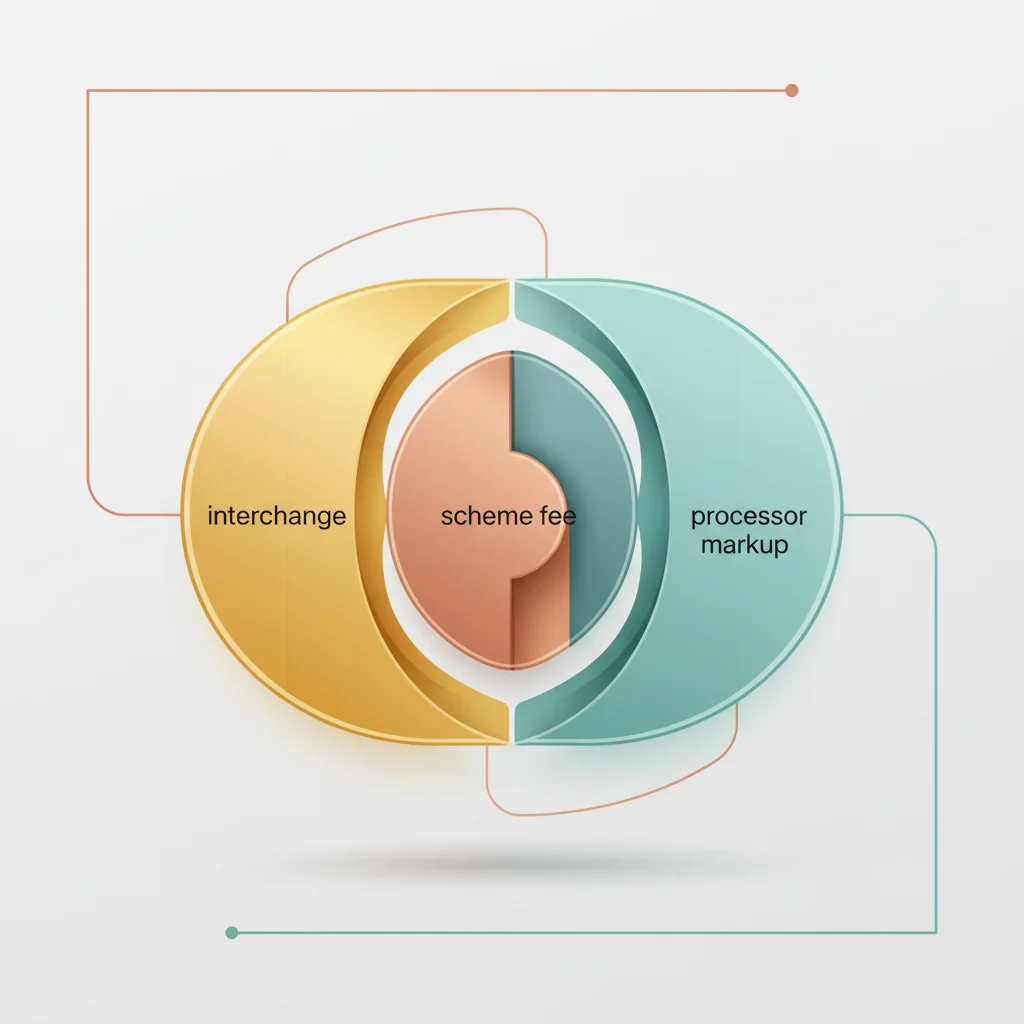
Interchange-Plus Pricing: Offered by Adyen and traditional merchant accounts, this model directly passes the raw cost of the transaction from the card issuer (Interchange Fee) and the card network (Scheme/Assessment Fee) to the merchant, adding a thin, pre-negotiated processor markup on top. If your store processes a large volume of domestic debit transactions, Interchange-plus can lower your average processing fee to 1.2% - 1.8%, saving thousands of dollars compared to a flat 2.9% rate. However, if your customer base relies on premium corporate or foreign rewards cards, your effective rate can easily climb above 3.0%, making accounting and margin forecasting far more complex.
Cross-Border Fees and Currency Conversion Rates
Cross-border sales are a key growth driver, but they require careful management of international transaction surcharges and currency conversion fees. When a consumer completes a transaction using a card issued outside the merchant’s corporate registration jurisdiction, the transaction is flagged as cross-border. Stripe automatically adds a 1.5% surcharge to the base processing rate for international cards. If a transaction also requires converting currencies to settle into the merchant's local bank account, Stripe charges an additional 1% to 2% currency conversion fee.
This means a US-based merchant selling to a UK buyer in GBP could face a total fee stack of up to 5.4% + $0.30 if settling in USD. To avoid these high margins, international businesses often establish localized business entities (e.g., a US LLC or a UK LTD) to secure domestic merchant accounts in those target markets. By routing local transactions to local acquiring banks, companies can bypass cross-border fees and currency conversion spreads entirely.
Chargeback Fees and Dispute Management Costs
A chargeback occurs when a consumer disputes a charge with their issuing bank rather than requesting a refund from the merchant. If a chargeback is initiated, the payment processor immediately pulls the transaction amount from the merchant's account, along with a non-refundable chargeback fee ranging from $15 to $30.
To defend against chargebacks, merchants must go through the representment process. This requires submitting digital evidence (such as proof of delivery, IP logs, and signed delivery confirmations) within strict card network deadlines. High chargeback rates pose a serious risk to your business operations. If your dispute rate exceeds the card network threshold (typically 1% of total transaction volume), your business will be placed in high-risk monitoring programs (e.g., Visa's VFMP). This leads to increased processing fees, mandatory rolling reserves, or even the immediate suspension of your merchant account.
Cash Flow Management: Settlement Times Compared

Standard Payout Schedules (T+1 vs. T+3)
Nakit akışı (cash flow management) is the lifeblood of e-commerce operations. Payout schedules, which define how quickly funds from a completed sale land in your bank account, vary significantly between providers and countries. The industry standard is typically referred to as T+X, where "T" is the transaction date and "X" represents the number of business days required for clearing and settlement.
In the US and UK markets, Stripe offers a standard T+2 payout schedule (2 business days) with no additional charge. For merchants facing tight inventory cycles, Stripe provides instant payouts for a 1% to 1.5% fee. In Turkey, payment service providers like PayTR and iyzico operate on custom payout schedules based on negotiation. While PayTR is highly regarded for its "ertesi gün ödeme" (T+1 / next-day payout) option, which is crucial for managing cash flow in inflationary environments, other providers may hold funds for 7 to 21 days (valör süresi) depending on the merchant’s risk profile and business age.
In the UAE, settlement timelines are traditionally longer. While Telr and PayTabs typically settle within T+5 to T+14 business days, global networks like Checkout.com can negotiate shorter clearing cycles (T+2 or T+3) for licensed corporate entities.
Factors Causing Rolling Reserves and Held Funds
A rolling reserve is a risk-mitigation strategy where a percentage of the merchant’s gross sales is held back in a non-interest-bearing reserve account for a set period (typically 90 to 180 days) to cover potential future chargebacks or refunds. Reserves are common for high-risk merchants, new businesses with no processing history, or companies that experience sudden surges in monthly sales volume.
The most common triggers for rolling reserves or complete account freezes include:
Sudden Volume Spikes: A merchant whose average monthly volume jumps from $10,000 to $150,000 within a few weeks will likely trigger automated risk alerts.
High Chargeback Rates: Exceeding a 1% dispute ratio often triggers an immediate reserve, typically holding 10% of all incoming funds for 180 days.
High Refund/Pre-order Timelines: Businesses selling custom-made furniture or pre-ordered goods with long fulfillment windows are flagged because of the extended period between payment and delivery, which increases the window for disputes.
Global Currency Support and Localization

Navigating Multi-Currency Processing Platforms
To scale globally, e-commerce stores must support multi-currency processing. This setup allows international shoppers to view pricing and complete checkout in their local currency, which significantly reduces cart abandonment. However, a major challenge is distinguishing between presentment currencies (the currency shown to the buyer) and settlement currencies (the currency the processor uses to deposit funds into the merchant's bank account).
If your store presents pricing in Euros (EUR) but your bank account is located in the US and only accepts US Dollars (USD), the transaction must undergo conversion. If the gateway manages this conversion, it typically adds a 1% to 2% currency conversion fee above the mid-market exchange rate. To optimize these costs, international e-commerce merchants configure multi-currency settlement structures. This involves setting up foreign currency bank accounts and configuring the gateway to route EUR payments directly to a EUR account and USD payments to a USD account, avoiding conversion fees entirely.
The Importance of Localized Payment Methods (iDEAL, Alipay, SEPA)
Accepting credit cards is no longer sufficient to capture global market share. Across many major economies, alternative and localized payment methods dominate the e-commerce landscape:
Europe (EEA): In the Netherlands, the bank-transfer system iDEAL handles over 60% of all online transactions. In Germany, bank transfers via Giropay or SEPA Direct Debit are highly preferred over credit cards.
United Kingdom: Faster Payments and open banking-driven account-to-account payments are rapidly growing as low-cost alternatives to traditional card networks.
United Arab Emirates & KSA: Saudi Arabia's local debit card network, Mada, is highly mandated for e-commerce; gateways like PayTabs and Telr that support Mada natively experience much higher conversion rates compared to global-only platforms.
Turkey: Due to high inflation, Turkish consumers rely heavily on credit card installments (Taksit). Gateways like iyzico and PayTR utilize direct bank integrations to detect the consumer's card BIN at checkout and display tailored installment plans in real time.
Alternative and High-Growth Payment Solutions

Digital Wallets (Apple Pay, Google Pay)
The adoption of digital wallets like Apple Pay and Google Pay has transformed checkout flows, especially on mobile devices. These systems utilize tokenization, replacing actual card numbers with a secure, single-use token to process payments. This process drastically reduces cart abandonment by eliminating the need for shoppers to manually enter their credit card numbers, billing addresses, and CVV codes during checkout.
From an integration standpoint, modern platforms like Stripe and Checkout.com support Apple Pay and Google Pay out of the box through a unified API. In the United Arab Emirates, under the government's Cashless Strategy to transition 90% of payments to digital methods by 2026, failing to support Apple Pay can cause an immediate 30% to 40% drop in checkout conversion rates. Additionally, because these wallets require biometric verification (such as FaceID or TouchID) at checkout, they natively comply with strict customer authentication rules, which significantly reduces unauthorized fraud disputes.
Buy Now, Pay Later (BNPL) Integration Risks and Rewards (Klarna, Afterpay)
Buy Now, Pay Later (BNPL) providers like Klarna, Afterpay, Tabby, and Tamara have become essential checkout additions for retail verticals like fashion, consumer electronics, and home decor. By allowing consumers to split their purchases into interest-free installments, BNPL solutions can increase average order value (AOV) by 30% to 40% and lower cart abandonment rates.
However, merchants must carefully weigh the high costs of these services:
High Transaction Fees: Unlike credit card processing, which typically costs 1.5% to 3.0%, BNPL providers charge merchants a high commission fee, often ranging from 4.0% to 6.0% plus a fixed transaction fee.
Integration Complexity: Managing refunds and disputes for BNPL purchases is more complex because merchants must coordinate with both their primary payment gateway and the BNPL provider's ledger.
Operational Cash Flow: While BNPL providers pay the merchant the full purchase amount upfront (minus their commission) and take on the consumer's credit risk, any customer returns require immediate manual ledger adjustments to avoid penalty fees.
Security, Compliance, and Risk Mitigation

Strict Adherence to PCI DSS Compliance
Any business that accepts, transmits, or stores credit card data must comply with the Payment Card Industry Data Security Standard (PCI DSS). The current standard, PCI DSS v4.0, places strict security requirements on merchants to prevent data breaches.
To minimize security liability and engineering costs, modern e-commerce stores avoid handling raw card data on their own servers. Instead, they use tokenization and hosted checkout pages provided by PCI-compliant gateways. This ensures that card details are encrypted directly on the buyer's device and sent straight to the processor, keeping the merchant's web servers completely out of the card data environment (CDE).
AI-Driven Fraud Detection and 3D Secure (3DS)
As online fraud tactics evolve, merchants must balance fraud prevention with user experience. Modern payment processors employ automated, machine-learning fraud detection systems, such as Stripe Radar or Adyen’s built-in risk engines, to analyze hundreds of data points (including device fingerprints, IP locations, and shopping behavior) in real time to block suspicious charges.
In addition, 3D Secure (3DS) protocols add an extra layer of authentication, such as a biometric scan or a one-time SMS passcode sent to the buyer's phone. Under Europe's PSD2 regulations, 3DS is mandatory for most online transactions. In Turkey, 3D Secure is highly favored by both banks and consumers, and processors like iyzico allow merchants to dynamically adjust their 3DS rules. If a transaction successfully passes 3DS authentication, the liability for any potential "unauthorized card use" chargebacks shifts from the merchant back to the card-issuing bank, protecting the store from direct fraud costs.
Safeguarding Against Account Freezes and Suspensions
An unexpected account freeze can instantly halt sales and damage an online business. Because payment aggregators like Stripe and PayPal onboard merchants quickly without manual upfront underwriting, they rely heavily on automated, post-onboarding risk algorithms to monitor account activity.
To minimize the risk of a sudden account freeze, e-commerce businesses should follow these operational practices:
Establish Direct Merchant Accounts: Once your monthly processing volume surpasses $50,000 to $100,000, consider transitioning from a payment aggregator to a dedicated merchant account with direct bank underwriting. This process involves a detailed upfront review of your business operations, but it results in a much more stable processing relationship.
Notify Processors of Sales Spikes: If you are planning a major marketing campaign or holiday sale that will cause a large spike in transaction volume, notify your payment processor's risk department in advance to prevent automated security freezes.
Keep Dispute Rates Under Control: Actively monitor your chargeback ratios and use automated alert systems (like Chargebacks911 or Verifi) to refund disputed transactions before they escalate into official card-brand chargebacks.
Final Verdict: Selecting the Optimal Processor for Your Business Model

Choosing the best payment gateway depends heavily on your target market, transaction volume, and technical resources:
For Early-Stage and Mid-Market Businesses (US & UK): Stripe remains the industry standard. Its transparent flat-rate pricing, quick setup, and developer-friendly APIs make it ideal for businesses focused on rapid growth and custom user experiences.
For High-Volume Enterprise Retailers: Adyen is the clear winner. Its direct access to card networks and transparent Interchange++ pricing structure significantly reduce transaction costs for businesses processing millions of dollars annually.
For Businesses Targeting the GCC Region (UAE & KSA): A hybrid setup using a local provider like PayTabs or Telr (for local card routing and native Mada/Apple Pay support), combined with Tabby or Tamara for BNPL, is the most effective way to maximize conversion rates.
For Turkish E-Commerce Stores: Local providers like PayTR and iyzico are essential. They provide native, multi-bank installment payment systems (Taksit) and next-day payout capabilities, which are crucial for navigating local inflation and consumer habits.
By carefully auditing your transaction mix, chargeback risks, and local payment needs, you can build a stable, cost-effective payment pipeline that protects your profit margins and scales with your business.
Frequently Asked Questions
Which payment gateway offers the lowest transaction fees?
The lowest transaction fees depend on your sales volume and card types. High-volume merchants save most with Adyen’s Interchange++ model, while early-stage businesses find Stripe’s domestic rates competitive.
Is Stripe definitively better than PayPal for international scaling?
Stripe is generally superior for global scaling due to its extensive support for 135+ local currencies, low exchange spreads, and deep API customization, whereas PayPal charges high cross-border transaction fees and conversion markups.
How can merchants mitigate high cross-border transaction costs?
E-commerce merchants can reduce cross-border fees by registering local business entities in their primary target markets and opening local merchant processing accounts to route transactions domestically.
What is the primary difference between flat-rate and Interchange++ pricing models?
Flat-rate models charge a fixed percentage for all transactions regardless of card type, while Interchange++ pricing directly passes the raw card-brand exchange fees to the merchant, adding a small pre-negotiated markup on top.
Can a business operate an e-commerce store in Turkey using Stripe or PayPal?
No, PayPal does not operate in Turkey due to licensing rules, and Stripe does not offer direct payouts to Turkish bank accounts. Turkish merchants must rely on local virtual POS providers like PayTR or iyzico.
Why is Apple Pay support critical for e-commerce checkouts in the UAE?
Apple Pay is a primary payment method in the UAE, and missing this integration can cause mobile cart abandonment rates to rise by 30% to 40% in that region.
What happens to original transaction processing fees when a customer refund is issued?
Standard payment aggregators like Stripe and PayPal do not return their original transaction processing fees during refunds, which creates a direct loss for the merchant on returned orders.
What is a rolling reserve and why do payment processors implement them?
A rolling reserve is a risk-mitigation tool where a processor holds a percentage of gross sales for 90 to 180 days to cover potential chargeback liabilities, commonly applied to high-risk merchants or accounts with sudden sales spikes.