
How Do AI Models Choose Which Sources to Cite?
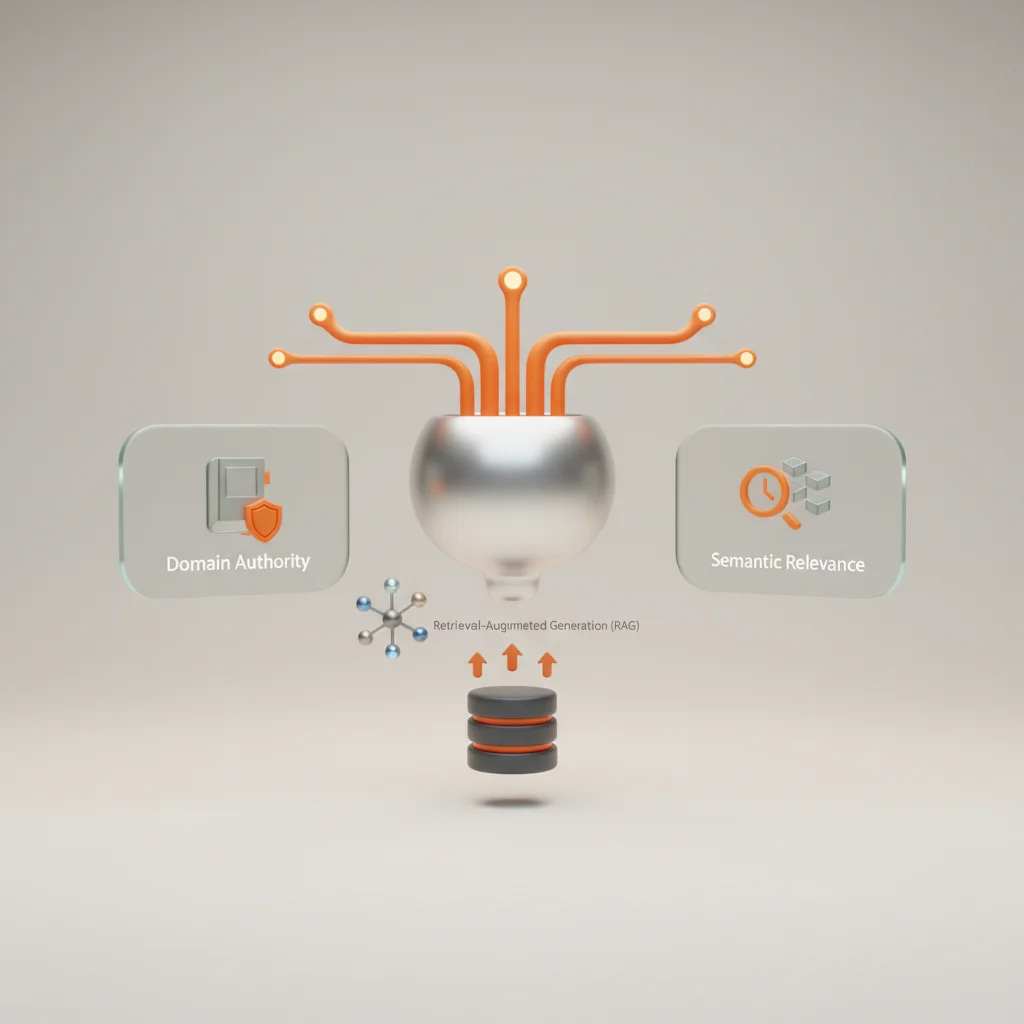
AI models use Retrieval-Augmented Generation (RAG) to cite sources, ranking data by semantic relevance, domain authority, and recency prior to generating outputs.
ON THIS PAGE
0% read
- The Core Mechanism: Understanding Retrieval-Augmented Generation (RAG)
- The 3 Pillars of AI Source Selection
- From Retrieval to Output: How the AI Formulates the Citation
- Enterprise Risks: Why AI Models Hallucinate Citations
- The Business Impact: Preparing for Generative Engine Optimization (GEO)
- The Evolution of Verifiable Enterprise AI Architectures
AI models use Retrieval-Augmented Generation (RAG) to cite sources, ranking data by semantic relevance, domain authority, and recency prior to generating outputs.
Understanding how modern artificial intelligence engines discover, evaluate, and reference external data has become a foundational imperative for technical leaders and digital strategists. When examining how do AI models choose which sources to cite, enterprise decision-makers must look beyond simplistic keyword matching and analyze multi-stage retrieval pipelines. Platforms like Perplexity AI, Google Gemini, OpenAI Search, and Microsoft Copilot rely on neural ranking, dense vector indexing, and real-time validation layers to substantiate generative outputs. This guide breaks down the computational mechanics of algorithmic source attribution, unpacks the criteria governing information retrieval, addresses enterprise citation fidelity risks, and outlines actionable frameworks for Generative Engine Optimization (GEO).
The Core Mechanism: Understanding Retrieval-Augmented Generation (RAG)
Large Language Models (LLMs) are fundamentally probabilistic sequence predictors trained on static corpora. While their parametric memory stores broad linguistic patterns and conceptual relationships, it cannot guarantee real-time factual accuracy or verified attribution out of the box. To bridge this structural limitation, modern search and enterprise AI engines deploy Retrieval-Augmented Generation (RAG). RAG transforms an LLM from an isolated text generator into an integrated research system capable of querying external knowledge bases, validating claims, and anchoring responses to specific source documents.
The RAG workflow operates across three distinct computational tiers: retrieval, augmentation, and generation. When an end user submits an inquiry, the system does not immediately query the generative model. Instead, the query passes through a neural retrieval engine that searches indexed web pages, private enterprise data, or vectorized knowledge repositories. The system parses thousands of candidate documents, extracts the most statistically relevant text passages, injects those snippets into the model's active context window, and prompts the LLM to generate an answer derived strictly from those retrieved inputs.
Understanding this architecture clarifies why AI attribution differs fundamentally from traditional search engine ranking. Traditional web search engines return indexed URLs based on link graph analysis, document-level keyword relevance, and behavioural metrics. AI citation engines, by contrast, evaluate micro-chunks of text—often 250 to 1,000 tokens in length—to determine whether a precise paragraph directly answers a sub-component of the prompt. Consequently, a high-ranking page in conventional search may be completely ignored by an AI model if its structural formatting prevents clean semantic chunking and extraction.
+---------------------------------------------------------------------------------------------------+
|                                 MODERN ENTERPRISE RAG PIPELINE                                    |
+---------------------------------------------------------------------------------------------------+
| 1. User Prompt  --> [ Query Expansion & Multi-Query Generation ]                                  |
| 2. Search Stage --> [ Hybrid Retrieval: Dense Vectors + Sparse BM25 Keywords ]                    |
| 3. Filter Stage --> [ Neural Cross-Encoder Re-ranking (Semantic Relevance, Authority, Recency) ]   |
| 4. Context Prep --> [ Context Compression & Chunk Token Optimization ]                            |
| 5. LLM Synthesis--> [ In-Context Generation with Attention-Driven Citation Attribution Tokens ]    |
| 6. Validation   --> [ Post-hoc Attribution Checking & Hallucination Guardrails ]                  |
+---------------------------------------------------------------------------------------------------+
During this pipeline, the language model uses attention mechanisms to calculate cross-token probabilities between the generated claims and the source chunks provided in its context window. When the system detects a direct informational dependency between an output sentence and a specific context passage, it appends a citation token linking to the originating domain. This multi-step process balances generative flexibility with factual verification, providing enterprise users with an auditable path back to primary data sources.
The 3 Pillars of AI Source Selection
AI search engines and enterprise retrieval pipelines select citation sources through a rigorous scoring matrix. Rather than relying on a single ranking factor, the retrieval engine applies a composite evaluation framework that weighs mathematical meaning, external reliability signals, and temporal metadata.
1. Semantic Relevance and Vector Embeddings
Semantic relevance is the mathematical foundation of modern neural information retrieval. Before an AI model can evaluate whether a source deserves citation, it converts both the user's prompt and billions of indexed web passages into high-dimensional vector embeddings. These vectors—typically ranging from 768 to 3,072 dimensions depending on the underlying embedding architecture—plot textual meaning in a geometric coordinate space.
Unlike legacy search engines that rely on exact-match keywords, dense retrieval models assess conceptual alignment. For example, if a user asks, "What are the data sovereignty requirements for cloud migration in DACH countries?", a vector-based search engine recognizes that documents mentioning "German federal data protection laws", "Swiss cloud security guidelines", or "GDPR compliance frameworks" share high cosine similarity with the query, even if the exact phrase "DACH data sovereignty" never appears in the text.
       Vector Cosine Distance Analysis (Simplified 2D Projection)

       [High Relevance Zone: Cosine Similarity > 0.82]
       * "Enterprise SOC2 Compliance Protocols" <--- (0.89) ---> [User Query]
       * "Cloud Data Governance Standards"     <--- (0.84) ---> [User Query]

       [Low Relevance Zone: Cosine Similarity < 0.45]
       * "Generic IT Support Services"         <--- (0.38) ---> [User Query]
       * "Commercial Web Hosting Discounts"    <--- (0.22) ---> [User Query]
Advanced retrieval pipelines utilize hybrid search models that combine sparse lexical scoring (such as BM25) with dense neural retrieval. This ensures that while the system captures broad conceptual nuances, it preserves precision for domain-specific terminology, product codes, and statutory references. If a passage exhibits high semantic proximity to the user's prompt during dense vector matching, it advances to the second phase of candidate ranking.
2. Domain Authority and Source Trustworthiness
Semantic relevance alone is insufficient for enterprise-grade citation. Generative search systems like Google Gemini and Perplexity AI operate under strict content-quality filters to mitigate the risk of amplifying disinformation, unverified claims, or low-quality promotional spam. Consequently, retrieval algorithms cross-reference semantic matches against algorithmic trust metrics and knowledge graph nodes.
In the AI retrieval paradigm, domain authority is measured through entity validation, technical consensus, and institutional recognition rather than backlink volume alone. AI models evaluate whether an author or publishing organization is mapped within major semantic knowledge graphs (such as Wikidata or proprietary enterprise entity registries). Sources that demonstrate clear Experience, Expertise, Authoritativeness, and Trustworthiness (E-E-A-T) receive positive ranking weights in retrieval-augmented cross-encoders.
Furthermore, AI engines look for cross-source validation. If a specific statistic, technical specification, or legal interpretation published by an organization is corroborated by independent academic papers, regulatory filings, or standard-setting bodies (such as ISO, NIST, or W3C), the system assigns a higher confidence score to that content chunk. Conversely, unverified claims originating from isolated domains with no established topical authority are aggressively filtered out prior to prompt generation.
3. Recency and Temporal Weighting
The temporal dimension of information is critical in business, financial, legal, and technological inquiries. AI engines apply mathematical decay functions to candidate documents, discounting sources that contain obsolete information while prioritizing recently validated data.
Temporal Score Formula Concept:
Final_Score = Base_Semantic_Score * exp(-decay_rate * (Current_Date - Document_Date))
For fast-moving queries—such as breaking market events, software framework version updates, or newly enacted regulatory compliance mandates—the temporal weighting multiplier dramatically shifts the candidate pool. Search systems inspect HTTP @@CODE0@@ headers, schema markup timestamps (@@CODE1@@ and dateModified), and chronological references within the text body to establish temporal authenticity.
However, recency weighting is query-dependent. For evergreen technical topics—such as fundamental sorting algorithms, foundational physics principles, or historical case studies—the decay rate is set near zero, allowing the system to prioritize foundational authority over publication date. For dynamic topics, systems like Perplexity AI and OpenAI Search execute multi-query temporal branching, retrieving documents from multiple time horizons to construct a chronologically coherent answer with explicit date citations.
A comparative evaluation of traditional keyword-based retrieval against modern embedding-driven neural search architectures. Avantaj Dense retrieval maps high-dimensional conceptual meaning and semantic intent. Dezavantaj Sparse retrieval requires exact keyword string overlap, missing synonyms and context. Avantaj Sparse retrieval (BM25) reliably extracts exact part numbers, acronyms, and legal codes. Dezavantaj Dense embeddings can occasionally blur distinct alphanumeric identifiers. Avantaj Dense vectors allow chunk-level contextual mapping directly into LLM attention layers. Dezavantaj Sparse methods often pull entire unstructured web pages requiring heavy manual post-filtering.Sparse Lexical Retrieval vs. Dense Neural Retrieval
Query Matching Logic
Technical Precision
Citation Utility for AI
From Retrieval to Output: How the AI Formulates the Citation
Extracting relevant documents is only the preliminary half of the citation workflow. Once the retrieval engine isolates the top 5 to 20 text passages from the web or internal data repositories, the generative model must synthesize the information and assign explicit source attributions to individual sentences.
+-----------------------------------------------------------------------------------------+
|                  CONTEXT WINDOW TOKEN ALLOCATION & ATTRIBUTION MAPPING                  |
+-----------------------------------------------------------------------------------------+
| [System Directive] "Synthesize answers strictly using the provided context chunks..."   |
|                                                                                         |
| [Chunk 1: ID#842 - Source: cisa.gov]                                                    |
| "Zero-trust architectures mandate strict continuous identity verification..."           |
|                                                                                         |
| [Chunk 2: ID#915 - Source: nist.gov]                                                    |
| "Micro-segmentation isolates network workloads to limit lateral threat movements..."   |
|                                                                                         |
| [LLM Output Synthesis]                                                                  |
| "To secure modern infrastructure, organizations must enforce continuous verification    |
|  [Chunk 1] while deploying workload micro-segmentation [Chunk 2]."                     |
+-----------------------------------------------------------------------------------------+
In-Context Learning and Prompt Augmentation
The selected source passages are formatted into structured context blocks and appended to the user prompt inside the LLM's active context window. This architecture relies on in-context learning, wherein the model is instructed to treat the provided passages as the sole ground-truth reference for the forthcoming response.
System instructions enforce rigorous citation constraints. A typical enterprise generation directive instructs the model: "Answer the user prompt based exclusively on the provided context snippets. For every factual assertion, data point, or direct claim, append the corresponding chunk identifier immediately after the statement." By constraining the generative model's sampling space to the provided context, developers minimize the likelihood that the model will default to ungrounded claims stored in its parametric memory.
Citation Fidelity and Attribution Mapping
During output token generation, the model's self-attention mechanism maps dependencies between the words it is producing and the token sequences located inside the context chunks. When the model writes a factual statement—for example, "Enterprise cloud spending increased by 18% year-over-year"—the attention weights assign high activation values to the specific context passage containing that metric.
Attribution mapping layers convert these attention activations into visible user-facing citations. Rather than simply linking to a generic website homepage, advanced AI search interfaces output deep links containing text fragments (such as Google's #:~:text= URL parameters) or anchor citations directly referencing the exact paragraph from which the data point was derived.
Reranking Pipelines: Cohere, BGE, and ColBERT
Between initial document retrieval and final context assembly, enterprise AI systems deploy dedicated re-ranking models to optimize citation accuracy. Initial vector database searches return a broad set of candidates based on bi-encoder embeddings, which evaluate the query and documents independently for computational speed.
Bi-Encoder (Fast Retrieval)           Cross-Encoder (Deep Re-ranking)
Query   --> [ Vector A ]              [ Query + Document ] --> [ Cross-Attention ]
                           \ Cosine                                      |
Document--> [ Vector B ] --/ Distance                              Final Score (0-1)
To eliminate false positives, cross-encoder re-rankers (such as Cohere Rerank, BAAI's BGE-Reranker, or ColBERT multi-vector scoring architectures) process the user query and candidate passages simultaneously. The cross-encoder computes full token-to-token attention across both inputs, identifying subtle contextual alignments, negations, or logical qualifications that bi-encoders miss. Only the top-scoring passages passing the cross-encoder's verification threshold make it into the final context window for citation.
Enterprise Risks: Why AI Models Hallucinate Citations
While Retrieval-Augmented Generation significantly improves generative accuracy, it does not eliminate enterprise risk. Business leaders must understand the structural failure modes that lead AI models to fabricate sources, misattribute quotes, or generate inaccurate citations.
The Disconnect Between Generation and Retrieval
The most common cause of hallucinated citations is the fundamental disconnect between probabilistic text generation and deterministic database retrieval. If an LLM is asked a highly specialized question for which the retrieval engine finds no relevant context passages, one of two things happens:
The system correctly identifies the context gap and declines to answer.
The model's generative probability distribution overrides retrieval constraints, synthesizing an answer from parametric memory while fabricating a plausible-looking citation format to satisfy the prompt structure.
In low-temperature or poorly grounded deployments, models may invent nonexistent academic papers, attribute valid research to the wrong authors, or combine real domain URLs with fabricated subpaths. This phenomenon—known as hallucinated provenance—presents severe legal, regulatory, and brand risks for enterprises publishing unverified AI outputs.
Data Poisoning and Low-Quality Inputs
AI citation engines are vulnerable to adversarial manipulation and low-integrity source data. If an organization relies on public web search indices without strict quality filtering, malicious actors can deploy Indirect Prompt Injection or Data Poisoning techniques.
+--------------------------------------------------------------------------------------+
|                     DATA INTEGRITY RISKS IN AI CITATION SYSTEMS                      |
+--------------------------------------------------------------------------------------+
| Risk Type               | Attack Vector               | Operational Impact           |
| :---------------------- | :-------------------------- | :--------------------------- |
| Indirect Prompt Injection| Hidden text inside web pages| LLM misattributes source or |
|                         | targeting LLM parsers       | outputs competitor bias      |
| Hallucinated Provenance | Parametric drift under      | Fabricated regulatory claims |
|                         | context token limits        | leading to legal exposure    |
| Temporal Stale Data     | Obsolete schema timestamps  | Citing expired pricing or    |
|                         | mimicking fresh updates     | discontinued API endpoints   |
+--------------------------------------------------------------------------------------+
By embedding hidden instructions within public web pages (e.g., text rendered off-screen via CSS), bad actors can instruct the reading LLM to prioritize a specific commercial entity or misrepresent legal compliance guidelines. Enterprise AI deployments must implement strict input sanitization and verification layers to scrub candidate chunks before passing them to the generative engine.
Intellectual Property, Provenance, and Compliance
From a regulatory standpoint (including the EU AI Act and global data privacy frameworks such as GDPR and CCPA), organizations deploying generative search tools must maintain an auditable chain of data provenance. When an enterprise AI assistant provides advice to clients or internal stakeholders, leadership must be able to verify whether the source material infringed copyright, violated proprietary licensing agreements, or ingested protected personal data. Establishing deterministic citation validation protocols is no longer just a technical luxury; it is a corporate compliance requirement.
An objective analysis of deploying automated RAG-based citation pipelines within corporate operations. Pros 2 advantages Scalable Information Verification Accelerates research cycles by instantly consolidating and referencing thousands of cross-departmental documents. Reduced Cognitive Load Direct deep-linking allows knowledge workers to audit source data in seconds without manual web navigation. Cons 2 concerns Residual Hallucination Exposure Models can occasionally misattribute context under high-complexity prompts without human-in-the-loop oversight. Compute and Latency Overhead Multi-stage retrieval, cross-encoder re-ranking, and context validation increase API costs and query response times.Automated AI Citation Pipelines in Enterprise Workflows
The Business Impact: Preparing for Generative Engine Optimization (GEO)
As conversational AI systems handle an increasing share of informational queries, corporate discovery is shifting from traditional search engine optimization (SEO) to Generative Engine Optimization (GEO). Winning citation visibility in systems like Perplexity AI, Google AI Overviews, and Microsoft Copilot requires restructuring enterprise web content for machine consumption.
       TRADITIONAL SEO                        GENERATIVE ENGINE OPTIMIZATION (GEO)
 [ Keyword Density & Page URLs ]             [ High-Density Semantic Concept Chunks ]
             |                                                  |
             v                                                  v
 [ Backlink Graph Authority ]                [ Knowledge Graph Entity Verification ]
             |                                                  |
             v                                                  v
 [ Rank for Blue Link SERPs ]                [ Selected as Primary Synthesized Citation ]
Optimizing Content Architecture for LLM Chunking
AI retrieval systems do not index web pages as holistic visual experiences; they ingest raw text broken down into discrete computational chunks. If an enterprise's technical insights are buried within sprawling, unstructured 4,000-word articles lacking clear contextual anchors, neural chunking algorithms will dilute the semantic score of the content.
To maximize citation eligibility:
Structure content around self-contained, high-density informational blocks containing 150 to 300 words.
Ensure every H2 and H3 section opens with a direct, unambiguous conceptual definition or factual assertion.
Use clear Markdown tables and standardized formatting to present structured data, specifications, and comparative matrices.
Eliminate conversational filler that dilutes token density without adding semantic value.
Establishing Entity Authority and Schema Breadcrumbs
Neural retrieval algorithms cross-reference extracted claims against structured data vocabularies. Enterprises must implement comprehensive @@CODE0@@ schema markup across all digital properties, clearly defining @@CODE1@@, @@CODE2@@, @@CODE3@@, and Author entities.
{
  "@context": "https://schema.org",
  "@type": "TechArticle",
  "headline": "Enterprise Zero Trust Implementation Standards",
  "author": {
    "@type": "Person",
    "name": "Dr. Elena Rostova",
    "jobTitle": "Chief Information Security Officer",
    "sameAs": "https://www.wikidata.org/wiki/Q00000000"
  },
  "publisher": {
    "@type": "Organization",
    "name": "Enterprise Security Institute",
    "url": "https://example.com"
  },
  "datePublished": "2026-08-27T08:00:00Z",
  "dateModified": "2026-08-27T09:30:00Z"
}
Linking author profiles to verified external entities in Wikidata, ORCID, or established corporate registries reinforces domain trustworthiness scores in AI knowledge graphs. When an AI search engine evaluates competing passages with equal semantic relevance, the passage tied to a verified, authoritative entity wins the citation slot.
Strategies for Perplexity AI, Google Gemini, and OpenAI Search
Different AI search platforms prioritize distinct retrieval signals. A comprehensive GEO strategy must account for these architectural nuances:
Perplexity AI: Heavily weights real-time web retrieval, academic index integration, and explicit structural clarity. Content featuring concise summary boxes, numbered methodologies, and bulleted takeaways achieves high citation frequency.
Google Gemini / AI Overviews: Relies on Google’s expansive core web index and Knowledge Graph. Deeply integrates traditional E-E-A-T signals, historical domain trust, and schema data alignment.
OpenAI Search: Prioritizes conversational context alignment, direct answer synthesis capability, and partner publication networks. It favors authoritative, clean HTML structures that allow direct text extraction without heavy client-side JavaScript rendering.
The Evolution of Verifiable Enterprise AI Architectures
The future of enterprise artificial intelligence depends on verifiable, auditable information pipelines. As organizations integrate LLMs into mission-critical operations, the industry is moving away from purely generative models toward hybrid architectures that enforce deterministic citation validation before any text reaches the user.
       UNGUARDED GENERATION                 DETERMINISTIC CITATION VALIDATION
    [ Prompt ] ---> [ LLM ]             [ Prompt ] ---> [ Neural Retrieval ]
                       |                                         |
                       v                                         v
              [ Output with Risk ]                      [ Context Assembly ]
              of Pure Hallucination                              |
                                                                 v
                                                        [ LLM Synthesis ]
                                                                 |
                                                                 v
                                                   [ Post-Generation Guardrail ]
                                                   * Attributed claim check
                                                   * Source token validation
                                                                 |
                                                                 v
                                                    [ Audited, Citable Output ]
Deterministic Citation Validation Networks
To guarantee citation fidelity, modern enterprise software stacks deploy post-generation validation guardrails (such as Guardrails AI, NeMo Guardrails, or proprietary cross-checking models). These secondary validation layers read the LLM’s generated response, parse every asserted claim, and programmatically verify whether that exact claim is mathematically supported by the retrieved source context chunks.
If an asserted sentence cannot be verified against the underlying context tokens, the validation engine automatically strips the claim or re-prompts the model with a tighter constraint. This deterministic feedback loop provides enterprise teams with the confidence required to deploy conversational AI across legal analysis, financial auditing, clinical support, and compliance workflows.
Hybrid Knowledge Graph and Vector Database Integrations
While vector databases excel at fuzzy semantic matching, they lack the rigid structural reasoning required for complex relational queries. The emerging standard for enterprise knowledge management is GraphRAG—a hybrid approach that integrates dense vector retrieval with explicit Knowledge Graphs.
By mapping enterprise concepts as interconnected entities, GraphRAG allows retrieval engines to query both semantic text vectors and explicit relationship paths. When generating citations, the system provides dual attribution: linking to the descriptive text passage and citing the validated entity relationship within the knowledge graph. This hybrid paradigm eliminates semantic ambiguity and represents the next frontier in robust, transparent AI information retrieval.
Frequently Asked Questions
What is the main reason an AI model chooses one source over another?
AI models select sources based on a combined score of semantic relevance (calculated via vector embeddings), domain authority (evaluated through Knowledge Graph trust and entity signals), and temporal recency. Content that directly and concisely answers the specific intent of a query receives the highest ranking in the retrieval-augmented generation pipeline.
How does Retrieval-Augmented Generation (RAG) work in search engines?
RAG breaks down web content into small text chunks, converts them into high-dimensional vector embeddings, and stores them in vector databases. When a user submits a prompt, the system retrieves the most relevant chunks, injects them into the language model's active context window, and prompts the model to synthesize an answer derived strictly from those cited sources.
Can an AI model cite a source without using exact matching keywords?
Yes. Modern AI models utilize dense neural retrieval, which maps conceptual meaning into multidimensional vector spaces. As long as the semantic intent of your content aligns closely with the user's query via cosine similarity calculations, the AI can select and cite your material even if the specific keyword phrase is absent.
What causes AI search engines to hallucinate fake citations?
Hallucinated citations occur when an LLM's probabilistic language generation overrides its retrieval constraints. If the retrieval layer fails to return sufficiently relevant source passages for a complex prompt, the model may attempt to satisfy the query by synthesizing plausible-sounding facts and fabricating non-existent URLs or academic papers from its parametric memory.
How does Generative Engine Optimization (GEO) differ from traditional SEO?
Traditional SEO focuses on optimizing whole web pages to rank in search engine results pages using keywords, site architecture, and backlink authority. GEO focuses on structuring content into high-density, modular text chunks, embedding comprehensive entity schema markup, and providing direct factual assertions that neural retrieval models can easily parse, extract, and cite in synthesized answers.
How frequently do AI retrieval models update their source index?
Indexing frequency depends on the platform's architecture. Systems like Perplexity AI and OpenAI Search perform real-time web retrieval for time-sensitive queries, updating citation sources dynamically within seconds. In contrast, enterprise internal RAG systems re-index their vector databases on scheduled batch intervals or via event-driven ingestion pipelines as new documents are published.
Does having strong schema markup help my website get cited by AI?
Yes. Structured data markup (such as JSON-LD) helps AI search engines identify the core entities, authors, publication dates, and topical relationships on a page without semantic ambiguity. Validating your organizational entities against recognized knowledge graphs significantly boosts domain trustworthiness scores during the retrieval re-ranking phase.
What is a re-ranking model and why is it important for AI citations?
A re-ranking model is a secondary neural network (often a cross-encoder) that evaluates candidate passages retrieved by the initial vector search. It analyzes deep token-to-token interactions between the user query and candidate passages to eliminate irrelevant context, ensuring that only the most contextually accurate and authoritative text chunks are sent to the LLM for citation.