
How to Choose Your First Programming Language
Selecting your first programming language is crucial for aspiring developers. Evaluate career goals, project types, and community support to make an informed decision for your software journey.

ON THIS PAGE
0% read
- The Strategic Importance of Your First Programming Language
- Key Factors to Consider for an Informed Decision
- Popular First Programming Languages: Use Cases and Considerations
- A Systematic Approach to Making Your Final Decision
- Common Pitfalls to Avoid During Your Selection Process
- Conclusion: Your Strategic First Step Towards a Rewarding Programming Journey
Selecting your first programming language is crucial for aspiring developers, business owners, and technical decision-makers alike. When learning how to start coding, this foundational choice shapes how you perceive algorithms, system architectures, and development workflows. Rather than treating this as a temporary trial, understanding How to Choose Your First Programming Language requires a structured evaluation of your career path in programming, market demands, and technical constraints. This comprehensive guide outlines the analytical steps required to select a language that aligns with your operational goals, project requirements, and cognitive style, ensuring your educational investment yields long-term professional returns.
The Strategic Importance of Your First Programming Language
Building Foundational Logic and Problem-Solving Skills
Selecting the best language to learn programming is not merely about memorizing syntax; it is about retraining your brain to decompose complex real-world problems into discrete, logical instructions. Your first coding language serves as the medium through which you internalize fundamental programming concepts. These structures include control flow statements (such as conditional branching and loop constructs), data encapsulation, memory allocation models, and functional abstraction.
When you learn to code, you build a mental model of how computers process information. Some languages abstract away complex computer hardware operations, allowing you to focus purely on algorithmic logic. Other languages force you to interact directly with system memory and computer processors, instilling a deep respect for resource optimization and execution efficiency. The logic patterns you master during this initial training phase will remain constant, regardless of how many new development frameworks emerge over the next decade.
Impact on Your Learning Path and Ecosystem Immersion
The developer roadmap you follow is heavily influenced by your initial language. Every coding ecosystem carries its own set of package managers, build automation tools, testing frameworks, and deployment patterns. For instance, stepping into Python for beginners introduces you to virtual environments, pip package indices, and scientific computing stacks.
Conversely, immersion in JavaScript for beginners immediately exposes you to asynchronous event-driven models, document object manipulation, and modern bundle configurations. This initial technical immersion shapes your software engineering habits, debugging strategies, and documentation standards. Starting with an ecosystem that features comprehensive, highly accessible resources prevents unnecessary friction and helps you build productive development habits from day one.
Setting the Trajectory for Your Future Career Development
From a corporate and human resources perspective, your initial choice of programming technology establishes the baseline for your early marketability. The alignment between your technical stack and current job market demand for developers dictates how quickly you can transition from an aspiring student to a contributing team member.
For organizational leaders and entrepreneurs, training personnel in a language with a broad, mature talent pool reduces recruitment costs and minimizes the operational risk associated with maintaining bespoke software platforms. Therefore, selecting a language must be viewed as a strategic business decision that directly influences hiring overhead, system scalability, and the long-term maintainability of your organization's digital products.
Key Factors to Consider for an Informed Decision
Your Career Aspirations and Industry Focus
The path you trace through the software engineering industry must dictate your choice of technology. The corporate enterprise sector operates on different architectural foundations than agile startup ecosystems. Large-scale financial institutions, insurance conglomerates, and healthcare providers frequently build and maintain their core transaction pipelines on statically typed, highly structured compiled environments.
Meanwhile, high-growth startups and software-as-a-service (SaaS) firms lean heavily toward dynamic, fast-to-deploy languages that facilitate rapid prototyping and continuous feature iteration. If your primary objective is to secure an engineering role within a multinational enterprise, your training should prioritize robustness and architectural discipline over quick deployment times.
The Types of Projects You Are Passionate About Building
Pedagogical research shows that project-based learning programming is the most effective methodology for acquiring and retaining coding skills for beginners. Consequently, the language you choose must support the creation of the specific digital products that interest you.
Web Applications: Frontend web development requires a native web development language that runs directly within modern client browsers, making client-side scripting engines mandatory. Backend server engineering relies on highly performant frameworks capable of database routing and API handling.
Data Systems and Analytics: Technical disciplines involving machine learning, data engineering, and automation require a powerful data science programming language that features mature matrix calculation libraries.
Mobile Platforms: Building applications for consumer smartphones demands specialized mobile app development language runtimes optimized for native operating system APIs.
Game Environments: High-fidelity interactive media development demands a specialized game development language that integrates with commercial graphics engines to manage real-time thread rendering.
Learning Curve and Accessibility for Beginners
The cognitive load associated with learning curve programming is a critical variable that can determine whether an aspiring developer succeeds or experiences early burnout. High-level languages abstract away manual memory allocation, pointer references, and complex static typing declarations, allowing you to quickly write functional code.
Low-level compiled languages require explicit type definitions, manual resource management, and complex structural configurations before a simple application can run. While high levels of abstraction accelerate initial learning, they can occasionally obscure how underlying computer hardware processes instructions. Striking a careful balance between syntactic simplicity and structural transparency is vital when selecting beginner-friendly programming languages.
Community Support, Documentation, and Ecosystem Robustness
No software engineer works in complete isolation. When you run into complex errors, run deployment pipelines, or design systems, you rely heavily on community support programming. A language with an active community ensures that bugs are identified and patched quickly, third-party libraries are actively maintained, and public knowledge bases like Stack Overflow are filled with relevant solutions.
Furthermore, checking the quality of official documentation is essential. Platforms backed by comprehensive, up-to-date guides, interactive learning tools, and clear API references significantly lower learning friction. This ecosystem support prevents developers from wasting valuable time on outdated dependencies or unpatched security vulnerabilities.
Popular First Programming Languages: Use Cases and Considerations
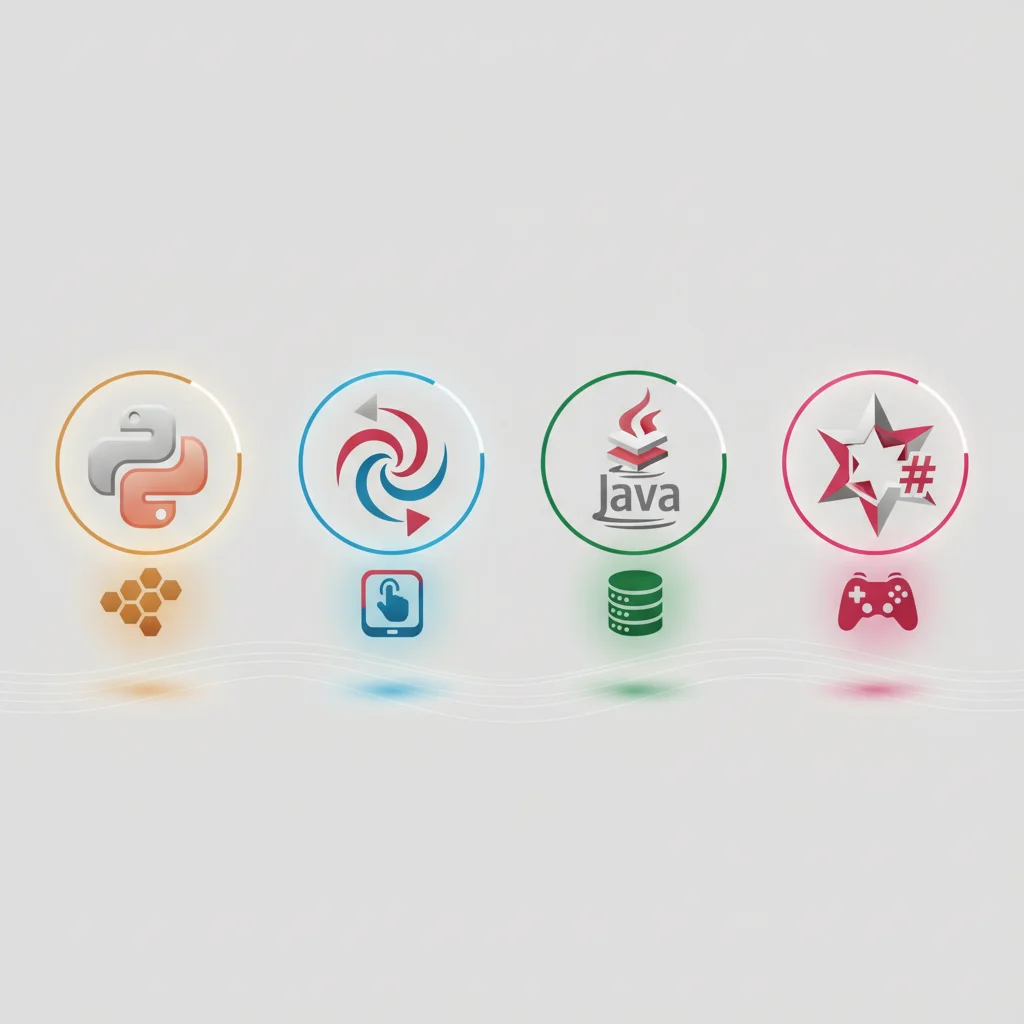
Python: The Versatile Gateway to Multiple Domains
Highly regarded as an exceptionally readable language, Python for beginners serves as a popular entry point into the software development industry [1]. Its clean, indentation-sensitive syntax resembles natural English prose, removing the initial syntactic barriers that often discourage new learners. By abstracting memory management and execution compilation, it allows developers to focus on fundamental algorithm design and logical data flows.
Python has established itself as the leading data science programming language, powering the global growth of artificial intelligence, machine learning, and advanced analytics. Through libraries like NumPy, Pandas, and PyTorch, it provides powerful tools for processing complex data structures. Beyond data science, Python powers web backend applications through high-performance frameworks such as Django and FastAPI, and automates administrative infrastructure tasks.
However, its interpreted nature makes execution speeds slower than compiled alternatives, and it is rarely used in native mobile development or resource-constrained embedded systems.
JavaScript: Dominating the Web Ecosystem
As the core language of modern web browsers, JavaScript for beginners offers an unmatched advantage: the ability to run code instantly inside any browser without complex local environments. It is the dominant web development language, controlling both user-facing client interfaces and backend server architectures. The immediate feedback loop of seeing your code alter a live browser interface makes learning highly visual and interactive.
With the development of Node.js, JavaScript expanded beyond frontend scripting into full-stack application development. This lets engineers build complete web platforms using a single language across the entire system. Its asynchronous event-driven design is built to handle multiple concurrent tasks, making it ideal for real-time web applications, chat systems, and interactive tools.
Despite these strengths, JavaScript features unique design quirks—such as dynamic type coercion, asynchronous callback complexities, and a rapidly changing frontend framework ecosystem—that require careful, disciplined study.
Java: Robustness for Enterprise and Android Development
Java for beginners introduces an environment governed by strict object-oriented design and static typing. Running on the Java Virtual Machine (JVM), it follows a "Write Once, Run Anywhere" philosophy, allowing compiled code to execute across diverse hardware platforms without recompilation. This structural independence has made Java a core pillar of enterprise software development, backend transaction engines, and large-scale banking systems.
Java's strict syntax forces beginners to explicitly define variable types, structure class systems, and implement robust error-handling protocols. While this increases the initial typing and setup required to run a basic program, it instills exceptional software development skills. It teaches software design patterns, memory safety principles, and system architecture fundamentals.
Additionally, Java remains a core language for Android mobile app development, though the verbose nature of its syntax can present a steeper initial learning curve compared to more concise options.
C#: Microsoft's Ecosystem and Immersive Game Development
Developed by Microsoft, C# for beginners is an elegant, statically typed, object-oriented language designed for the .NET framework. C# blends the rapid development features of high-level languages with the structural safety and execution performance of compiled systems. Its modern syntax includes powerful features such as Language Integrated Query (LINQ), asynchronous stream processing, and explicit type safety checks.
Within the technology market, C# is highly valued across two major domains:
Enterprise Architectures: It acts as the backbone for corporate web APIs, cloud microservices via Microsoft Azure, and secure desktop applications.
Game Engineering: It is the primary programming language for Unity, one of the world's most widely used game engines, making C# the industry standard for game development language training.
With the cross-platform capabilities of modern .NET (including versions .NET 8 and .NET 9), C# code runs efficiently across Windows, Linux, macOS, and mobile devices. This cross-platform utility makes it a versatile choice for developers targeting multi-platform deployments.
A Systematic Approach to Making Your Final Decision
Step 1: Clearly Define Your 'Why' and Envision Your Future
Before writing a single line of code or purchasing educational materials, you must clearly define your core motivation. If your goal is to automate repetitive excel reports and build internal business analytics dashboards, your educational needs will point directly to data analysis tools. If you are an entrepreneur aiming to build a lightweight web-based MVP to secure seed funding, your requirements will focus on rapid-development web stacks.
Aligning your training with your actual business goals, rather than pursuing general technical advice, prevents aimless study. Clearly defining your target industry segment from the start ensures you learn highly relevant skills.
Step 2: Research, Shortlist, and Compare Based on Criteria
Once you have identified your target domain, research current employment demands and technology stacks used by local and global organizations. Inspect regional job boards, examine active open-source repositories on GitHub, and read industry publications like the annual Stack Overflow Developer Survey.
This research will help you narrow your options down to two candidate technologies. Compare these finalists using objective metrics: check local developer salary expectations, evaluate the time required to build a standard local development environment, and assess the depth of beginner-focused courses available for each stack.
Step 3: "Try Before You Commit" – Engage with Introductory Projects
Avoid the trap of choosing a language based entirely on theory. Spend approximately ten to fifteen hours executing basic syntax exercises on free, interactive web-based platforms before investing in advanced bootcamps or professional certifications.
Build a basic calculator script, write a program that prints a sequence of numbers, or create a simple web scraper. This hands-on phase allows you to experience the actual code syntax, evaluate the helpfulness of compiler errors, and check how intuitive the language feels to write. If a language's structural rules feel overly frustrating, exploring your shortlisted alternative early on can prevent frustration.
Step 4: Choose One Language and Commit to a Deep Dive
After testing your options, make your final choice and commit to it fully. A common mistake made by new learners is "language hopping"—switching between languages every few weeks in search of an easier path. This habit delays progress because it prevents you from mastering core computer science concepts.
Commit to your chosen language for a minimum of ninety days. Use this period to dive deep into data structures, algorithm optimization, API integrations, and code testing patterns. Building a strong foundation in one language makes learning your second or third technology significantly easier later in your career.
Follow these sequential steps to successfully choose and learn your first language. Identify if your goal lies in web, enterprise software, game development, mobile, or AI. Select two languages that dominate your chosen sector based on industry standards. Build a small, basic script in both languages to test their developer tooling and syntax feel. Select the one that feels more intuitive and focus exclusively on it for at least 90 days.Decision Pipeline
Define Your Target Industry
Shortlist Two Candidates
Spend Ten Hours Coding
Make Your Commit
Common Pitfalls to Avoid During Your Selection Process
Chasing the "Hottest" Language Without Personal Alignment
The software engineering industry experiences rapid hype cycles, with emerging languages and frameworks frequently gaining attention on technical forums. Aspiring developers often make the mistake of choosing complex systems languages or niche smart contract technologies simply because they are popular in online discussions.
Learning these advanced languages without first mastering fundamental programming concepts like memory management, computer networking, or data structures often leads to extreme confusion. It is far more strategic to build your core skills using stable, widely adopted, and well-documented languages before branch out into specialized technologies.
Getting Trapped in "Tutorial Hell" Without Building Projects
Passively watching video tutorials and copying code line-for-line creates an illusion of progress. This pattern, commonly known as "tutorial hell," shields you from the actual work of software engineering: writing code from scratch and resolving compiler errors.
To build genuine coding skills, you must practice project-based learning. Write original code, encounter bugs, read technical documentation, and debug errors independently. The true learning process occurs when you resolve unexpected run-time exceptions, structure database relationships, and deploy application code to live servers.
Over-Optimizing for Salary Alone While Ignoring Interest
While evaluating salary expectations programming is an important part of career planning, choosing a technology based entirely on senior-level salary metrics is highly risky. Specialized, niche languages often show high average salaries in surveys because of a shortage of senior engineers who maintain legacy enterprise architectures.
For a complete beginner, starting with these highly complex or older systems can be frustrating due to sparse educational resources and complex syntax structures. If you lack interest in the language's primary use case, you are much more likely to abandon your studies before reaching a professional level.
Fear of Switching Languages Later in Your Career
Many new developers hesitate to begin because they fear that choosing their first coding language is a permanent, career-defining decision. This is a common misconception. The primary objective of your first language is to teach you how to think like a software engineer.
Once you understand core programming concepts—such as variable scope, data structures, asynchronous programming, and object-oriented inheritance—transitioning to another language is straightforward. Professional software developers frequently switch languages and stacks as system architectures and company requirements evolve.
Conclusion: Your Strategic First Step Towards a Rewarding Programming Journey

Recap of Key Decision-Making Principles
Choosing your first programming language requires balancing multiple key factors. By aligning your chosen technology with your specific career goals, evaluating its learning curve, and ensuring it has a strong, supportive community, you set yourself up for a successful educational journey. Rather than searching for an elusive "perfect" language, focus on finding a robust, well-established tool that directly supports the projects you want to build.
Encouragement to Start Building and Experimenting
The most critical step in learning to code is simply to begin writing code. Treat errors and bugs not as failures, but as essential opportunities to improve your debugging skills and deepen your technical understanding. Consistency is key; dedicated, daily practice is far more effective than occasional, marathon study sessions. Dedicating time each day to active, hands-on programming will help you steadily build the skills needed to design, develop, and maintain modern software systems.
The Future of Your Software Development Career Awaits
As you begin your development journey, remember that technology is constantly evolving. The languages and frameworks in demand today will continue to mature, and new technologies will emerge. By focusing on mastering core computational logic, algorithmic problem-solving, and clean coding practices, you build a versatile skill set that will serve you throughout your career. Your first language is simply the gateway to a wide range of opportunities in software engineering—take that first step with confidence and start building.
Frequently Asked Questions
What is the absolute easiest programming language for a complete beginner?
Python is widely considered the easiest programming language for beginners due to its clean syntax and readability, which closely resembles written English. This allows new learners to focus on mastering programming concepts and logic rather than struggling with complex syntax rules.
Which programming language offers the highest job demand and salary potential?
While specialized languages like Go, Scala, or Rust command high salaries, JavaScript and Python offer the highest volume of job opportunities globally. To maximize potential, focus on languages with substantial enterprise backing and widespread adoption in high-growth fields like cloud computing and AI.
Can I effectively learn two programming languages simultaneously as a beginner?
Learning two languages at the same time is generally not recommended for beginners. It often leads to confusion over syntax rules, variable declarations, and execution environments, which slows down the mastery of core programming fundamentals.
Is it detrimental to my career if I decide to switch my primary language later on?
No, switching languages is a natural and common phase in a developer's career trajectory. Once you understand core principles like object-oriented programming, data structures, and algorithms, picking up a new language takes significantly less time.
How long does it typically take to learn your first programming language?
Gaining a solid foundation in your first language generally takes three to six months of consistent, daily practice. Achieving professional-level proficiency to build complex production systems typically requires a year or more of project-based development.
Should I learn HTML and CSS before choosing a programming language?
If your goal is web development, mastering HTML and CSS is a necessary prerequisite before learning JavaScript. While HTML and CSS are markup and styling languages rather than programming languages, they provide the essential structural foundation for web applications.
Do I need a degree in computer science to learn how to start coding?
A formal computer science degree is not required to learn how to code or secure a job as a developer. Many successful software engineers are self-taught or come from alternative educational backgrounds, relying on personal project portfolios to prove their skills.
What is the best language to learn programming for mobile app development?
For native iOS development, Swift is the industry standard, while Kotlin is preferred for Android applications. If you want to build cross-platform mobile apps using a single codebase, JavaScript (with React Native) or Dart (with Flutter) are highly effective choices.