
How to Draft a Distance Selling Agreement for Your Store
A distance selling agreement outlines consumer rights, return policies, and seller obligations. Learn the mandatory clauses for legal e-commerce compliance.

ON THIS PAGE
0% read
Drafting a clear, legally compliant distance selling agreement is a fundamental operational necessity for modern online retailers operating across international borders. Understanding how to draft a distance selling agreement for your store is essential not only to satisfy local regulatory bodies in regions such as the United States, the United Kingdom, Turkey, and the United Arab Emirates, but also to build trust with consumer bases and protect the commercial entity from operational vulnerabilities. This guide provides an operational breakdown of the mandatory clauses, regional legislative variations, drafting stages, implementation protocols, and integration methods required to establish a legally binding e-commerce checkout framework.
Understanding the Distance Selling Agreement and Its Legal Importance

Every transaction completed over the internet, telephone, or mail order constitutes a distance sale. In these scenarios, the consumer does not have the opportunity to physically inspect the product or interact in person with the merchant before finalizing the purchase. Because of this inherent asymmetry of information, consumer protection authorities globally enforce strict guidelines to safeguard buyers. The distance selling agreement functions as a legally binding contract that establishes the rules of engagement, minimizing operational risks such as chargebacks, payment gateway disputes, and regulatory penalties.
Implementing a robust agreement ensures that your e-commerce platform complies with territorial consumer laws. These regulations are not static; they adapt to shifting digital trade landscapes. Failing to establish an enforceable contract can lead to severe operational issues, including payment processor suspension, legal prosecution, and the unilateral cancellation of transactions by consumer courts. By proactively structuring this document, merchants create a predictable framework for returns, liability, and dispute resolution.
What Constitutes a Distance Sale?
A distance sale is legally defined as any transaction concluded between a professional supplier and a consumer under an organized distance sales or service-provision scheme. This process relies exclusively on one or more techniques of distance communication up to and including the moment at which the contract is concluded. This encompasses web-based checkouts, mobile application purchases, mail-order catalogs, and telephone-based ordering systems.
The core legal distinction lies in the absence of simultaneous physical presence. When a customer initiates and completes a purchase online, they are protected by distance selling regulations that grant them specific rights not typically afforded to in-person shoppers, such as statutory cooling-off periods and mandatory pre-contractual disclosures. The contract is executed electronically, which demands high standards of digital verification to prove consent and compliance.
The Difference Between B2B and B2C Compliance Requirements
Many e-commerce operators mistakenly apply consumer-facing distance selling agreements to business-to-business (B2B) transactions. This is a critical operational error. Business-to-consumer (B2C) transactions are governed by mandatory consumer protection statutes that cannot be overridden by contractual terms. Under B2C frameworks, the consumer is legally deemed the weaker party, requiring protective interventions such as the right of withdrawal and strict information disclosure mandates.
Conversely, B2B transactions operate under the principle of freedom of contract. Businesses are expected to possess commercial competence, meaning that statutory cooling-off periods do not apply unless explicitly negotiated. In B2B distance contracts, merchants can limit liabilities, restrict return windows, define custom arbitration protocols, and set strict warranty conditions that would otherwise be declared null and void in a B2C context. Your online store must maintain distinct checkout paths and agreements for consumer retail and business wholesale clients to preserve these legal distinctions.
Key Legal Frameworks to Consider (EU Consumer Rights Directive & UK CCR)
For merchants selling to European and British consumers, compliance is dictated by two major statutory instruments: the European Union Consumer Rights Directive (Directive 2011/83/EU) and the United Kingdom Consumer Contracts (Information, Cancellation and Additional Charges) Regulations 2013 (commonly referred to as the UK CCR). These frameworks harmonize consumer protection across their respective jurisdictions, creating highly standardized requirements for digital sellers.
Both the EU Directive and the UK CCR mandate that consumers receive comprehensive pre-contractual information in a clear and comprehensible manner before completing their purchase. This includes detailed pricing, delivery terms, and the provision of a statutory 14-day cooling-off period during which consumers can cancel the order without giving any reason. If a merchant fails to provide clear information regarding this right of withdrawal, the statutory return period can automatically extend by up to 12 months, creating a massive operational and financial liability for the business.
Regional Regulations: Turkey (TKHK) and the United Arab Emirates (AE)
E-commerce businesses targeting Turkey and the United Arab Emirates must navigate highly specific, localized legal landscapes. In Turkey, distance contracts are governed by Article 48 of the Consumer Protection Law No. 6502 (TKHK) and the Distance Contracts Regulation (Mesafeli Sözleşmeler Yönetmeliği). The Turkish framework requires two separate documents at checkout: the Preliminary Information Form (Ön Bilgilendirme Formu) and the Distance Sales Contract (Mesafeli Satış Sözleşmesi). Both documents must be explicitly accepted by the consumer, and the merchant must retain digital records of these approvals for at least three years, ready to be audited by the Ministry of Trade.
In the United Arab Emirates, consumer transactions are governed by Federal Decree-Law No. 5 of 2023 on Consumer Protection, alongside specific guidelines enforced by the Dubai Department of Economy and Tourism (DET). The UAE framework places a strong emphasis on bilingual transparency (Arabic and English), clear invoicing, and fair refund policies. While the UAE does not impose an EU-style statutory 14-day unconditional right of withdrawal, it mandates that any merchant-established return policies must be clearly disclosed before purchase, and any defective items must be replaced or refunded without cost to the consumer.
Mandatory Clauses: What Must Be Included in Your Agreement

To withstand legal scrutiny and protect your digital storefront, your distance selling agreement must contain precise, non-negotiable clauses. Standard boilerplate templates often omit critical operational details or reference obsolete regulations, rendering the contract unenforceable. Each clause must be tailored to the actual supply chain capabilities, payment methods, and geographic reach of your store.
Structuring these clauses requires a balance between legal precision and clear communication. Legalese should be used to protect the business, but the text must remain sufficiently clear to satisfy the disclosure requirements mandated by consumer protection regulators. The following clauses form the core architecture of an enforceable distance selling contract.
Complete Corporate Identity and Contact Information
Your agreement must provide the customer with unambiguous details regarding who they are contracting with. This is a foundational step under all major consumer protection frameworks, designed to prevent fraudulent anonymous operations. Anonymous storefronts face instant flag flags from major payment gateways such as Stripe, Adyen, and PayPal.
The identity clause must state the full registered commercial name of the company, physical headquarters address, trade registry number, tax identification details, and rapid-contact channels (including a dedicated support telephone number and monitoring email address). If you utilize third-party fulfillment centers, the returns address must also be explicitly stated if it differs from the corporate headquarters.
Clear Product or Service Specifications
To mitigate chargebacks based on "significantly not as described" claims, the contract must define the exact parameters of the goods or services being sold. While individual product details are dynamically generated on the product page, the distance selling agreement must outline how these specifications are incorporated into the legally binding contract.
The clause should state that the product description, including dimensions, compatibility, material composition, and software requirements, is defined by the details provided on the specific product page at the time of purchase. For digital products, this clause must also clarify technical protection measures, system compatibility requirements, and digital rights management (DRM) restrictions.
Transparent Pricing, Taxes, and Hidden Fees
Price transparency is a primary target of consumer protection enforcement. Under laws like the UK CCR and FTC rules in the US, all pricing must be presented on an all-inclusive basis before the final checkout action.
The agreement must state that the listed price includes all applicable taxes, such as Value Added Tax (VAT) or State Sales Tax, where the merchant is legally obligated to collect them. It must clearly outline any extra fees, including shipping, handling, packaging, or environmental surcharges. For international shipments, the contract must explicitly state whether the consumer is responsible for local import duties, customs clearance, and associated administrative broker fees upon delivery.
Payment Terms and Secure Transaction Details
The agreement must explicitly state the accepted payment instruments, payment processing timelines, and security protocols utilized by your store. This section protects the merchant from payment disputes and establishes the legal point at which a transaction is authorized and captured.
The clause should outline the handling of multi-stage payments, such as pre-orders, down payments, or recurring subscription fees. It must state that billing occurs immediately upon order placement or shipment, depending on your gateway architecture. It should also reference compliance with PCI-DSS (Payment Card Industry Data Security Standard) and 3D Secure verification protocols to assure buyers and processors of secure transaction processing.
Delivery Commitments and Shipping Costs
A critical operational point of friction in e-commerce is fulfillment speed. Under the US FTC Mail Order Rule, if a seller fails to ship within the stated time frame (or within 30 days if no time frame is specified), they must notify the customer of the delay and offer a full refund.
The delivery clause must define the shipping zones, estimated delivery windows, and the exact methods used to calculate shipping fees. It should explicitly state the point at which the risk of loss or damage passes from the seller to the buyer. Under EU and UK laws, this risk remains with the seller until the consumer or a designated third party physically takes possession of the goods.
The Right of Withdrawal (14-Day Cooling-Off Period)
For EU, UK, and Turkish markets, the right of withdrawal is a non-negotiable statutory requirement. The agreement must outline how the customer can exercise this right, the 14-day duration of the cooling-off period, and the procedures for initiating a cancellation.
The clause must clearly specify:
The starting point of the 14 days (typically the day after the consumer receives the goods).
The absolute requirement for the consumer to provide an unequivocal statement of cancellation.
The processing timeline for refunds, which must occur within 14 days of receiving the returned items or proof of shipment.
Who bears the direct cost of returning the goods. If the agreement does not state that the consumer is responsible for return shipping, the merchant must pay those costs by default.
Exceptions to the Right of Withdrawal (Custom or Perishable Goods)
While consumer protection laws favor the buyer, they also recognize that certain goods cannot be returned due to their nature. Your agreement must clearly state these exceptions to prevent consumers from demanding refunds on un-resellable inventory.
The statutory exceptions include custom-made or personalized items, goods that deteriorate rapidly (perishables), sealed goods that are not suitable for return due to health protection or hygiene reasons if unsealed after delivery, and unsealed audio, video, or software recordings. For digital downloads, the right of withdrawal can be waived, provided the consumer gave explicit prior consent to begin the download during the cooling-off period and acknowledged that they would lose their right of withdrawal as a result.
Dispute Resolution and Governing Law
In cross-border e-commerce, determining which jurisdiction governs contractual disputes is complex. Your agreement must contain a clear choice of law clause and a dispute resolution mechanism to keep legal costs predictable.
This clause should designate the primary governing law (e.g., the laws of England and Wales, or the state of Delaware, or Turkish Consumer Law) and specify the courts that hold jurisdiction over disputes. For B2C contracts, however, you must note that mandatory local consumer rights of the buyer’s home country cannot be completely bypassed by a choice of law clause, meaning local courts may still apply consumer protection provisions.
Step-by-Step Guide to Drafting Your Distance Selling Agreement
Drafting your distance selling agreement is an operational task that must align with your store's practical logistics and technology setup. Simply copying an agreement from a competitor can expose your store to massive liability if their fulfillment model, payment systems, or return logistics differ from yours.
This step-by-step process ensures your agreement matches your operational realities. Follow these steps to build a customized, legally defensible, and highly accurate document.
Step 1: Audit Your Operational Capabilities and Supply Chain
Before putting pen to paper or typing a single clause, you must map out your operational capabilities. Your supply chain determines what timelines you can legally commit to in your contract.
You must analyze:
Average order handling times at your warehouse or third-party logistics (3PL) provider.
Actual shipping transit times across different shipping tiers and geographic regions.
The handling of lost, delayed, or damaged packages by your shipping carriers.
Your current system for managing incoming returned inventory, including inspection and restocking processes.
Step 2: Use Plain Legal English (Avoiding Ambiguity)
Consumer protection regulators actively penalize merchants who hide critical terms behind complex legal jargon or dense blocks of text. Your agreement must be easily readable by average consumers.
When drafting:
Use short, direct sentences with clear active voice.
Structure the document with logical H2 and H3 headings.
Define technical or operational terms early in the agreement.
Avoid archaic legalese like "heretofore," "wherefore," or "hereinafter."
Use bold formatting for critical terms, such as cancellation windows, return fee liabilities, and shipping limitations.
Step 3: Align the Agreement with Your Store's Return Policy
A common mistake in e-commerce setup is having a user-friendly "Refund Policy" page that contradicts the formal "Distance Selling Agreement" linked at checkout. If a dispute arises, these contradictions can invalidate your terms or result in payment gateways ruling in favor of the consumer.
Ensure that every parameter—such as the exact number of days allowed for returns, who covers return shipping costs, and the condition of the returned item—is identical across your Return Policy, Shipping Policy, FAQ pages, and the Distance Selling Agreement. The agreement should serve as the formal legal expression of the processes described in your consumer-facing pages.
Step 4: Consult with Legal Counsel for Jurisdiction-Specific Adjustments
While this guide establishes the technical and structural standards for a distance selling agreement, e-commerce laws vary widely across jurisdictions. A single clause that is compliant in the US may be illegal and invalid in the UK or Turkey.
Once you have drafted your core agreement, have it reviewed by qualified legal counsel in your primary target markets. They can help you draft specific addenda for regional buyers, such as the mandatory Turkish "Ön Bilgilendirme Formu" or specific California consumer disclosures, ensuring total compliance with local state and federal laws.
The operational sequence required to build, align, and finalize your agreement. Analyze fulfillment speeds, shipping zones, and return processing workflows to set realistic contract terms. Write clear, structured clauses, avoiding unnecessary legalese to meet strict regulatory readability standards. Eliminate contradictions between your store's return policy pages, checkout terms, and internal procedures. Engage legal experts in TR, US, UK, and AE to review regional adaptations and confirm absolute regulatory compliance.Strategic Drafting Process
Map Operational and Logistics Capabilities
Draft the Agreement in Plain Language
Align Public Policies with Legal Terms
Execute Localized Legal Audits
Critical Mistakes to Avoid When Drafting the Contract
Many digital brands expose themselves to unnecessary legal liabilities, high return rates, and financial penalties due to preventable drafting errors. In e-commerce compliance, minor oversights in contract structure can have severe consequences, including payment processor shut-downs or mandatory consumer refunds with no return of the goods.
Understanding these common pitfalls allows you to protect your profit margins and maintain healthy merchant accounts. The following operational mistakes are the most frequent causes of legal vulnerability in online retail.
Failing to Provide Information Before the Point of Purchase
A fundamental requirement under the Consumer Rights Directive and the UK CCR is the delivery of pre-contractual information. You cannot legally bind a customer to terms that were only disclosed after they submitted their payment details.
Your platform must present all critical details, including total pricing, shipping fees, withdrawal rights, and delivery timelines, directly on the final checkout page. If these details are only visible in a post-purchase confirmation email or on a page accessible after checkout, the consumer is not legally bound by them, and their statutory right of withdrawal may be extended by law.
Using Outdated or Generic Templates from Competitors
Copying and pasting another store's terms is one of the most common shortcuts in online retail setup. This practice carries severe operational risks. You may inadvertently adopt terms that reference incorrect legal jurisdictions, mention payment methods your store does not accept, or cite repealed legislation.
Furthermore, generic templates often lack specific protections for your unique product catalog. For example, if you sell software-as-a-service (SaaS) or digital downloads, utilizing a physical goods agreement template will completely fail to protect you against immediate consumption refunds, exposing your business to heavy serial return abuse.
Obscuring Liability Clauses and Warranty Terms
To make terms look appealing, some merchants obscure their limitation of liability clauses or hide strict warranty conditions deep within the agreement. If a consumer takes legal action, courts will often strike down hidden or unconscionable liability waivers.
Under standard consumer law, limits of liability must be clear, conspicuous, and reasonable. You cannot legally disclaim liability for gross negligence, intentional misconduct, or physical injury caused by a defective product. Obscuring these terms or using blanket "No Liability Under Any Circumstance" statements can invalidate your entire agreement in a court of law.
Implementing the Agreement on Your E-Commerce Platform
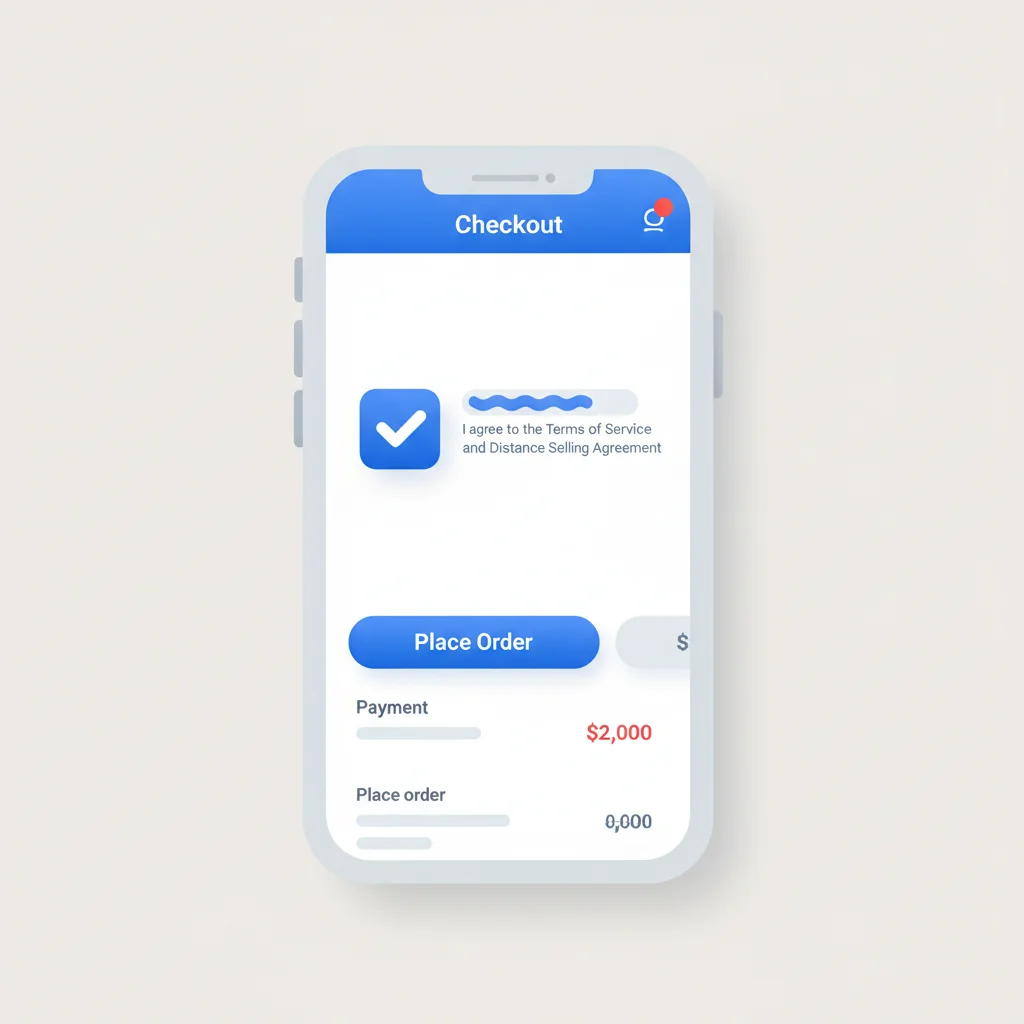
Having a perfectly drafted distance selling agreement is useless if your e-commerce platform fails to implement it in a legally binding manner. The technical execution of how a user accepts your contract is just as important as the text itself.
Your developer team or e-commerce strategist must structure the checkout flow to ensure that user consent is active, verifiable, and logged. The following implementation standards apply to Shopify, WooCommerce, Magento, and custom headless commerce stacks.
Browsewrap vs. Clickwrap: Securing Explicit Consent
There are two primary methods for presenting agreements to online shoppers: browsewrap and clickwrap. Browsewrap relies on passive consent, placing links to the terms in the website footer and assuming that because the user browses the site, they agree to the terms.
Global courts consistently rule that browsewrap is insufficient for B2C e-commerce. To be legally enforceable, you must use a clickwrap agreement. This requires the user to actively click a checkbox confirming "I agree to the Distance Selling Agreement and Terms of Service" before they can complete their purchase. This active step provides verifiable proof of explicit consent.
Best Practices for Check-Out Page Placements
To ensure compliance with the FTC, UK CCR, and Turkish Ministry of Trade, the clickwrap checkbox must be placed in close proximity to the final purchase button. It must not be buried under promotional banners or other distracting visual elements.
The checkbox must remain unselected by default. Pre-checked boxes do not constitute active consent under EU GDPR and UK consumer protection standards. The text next to the checkbox must contain a direct, working link that opens the Distance Selling Agreement in a new browser tab or modal window, ensuring the user can easily review the terms without disrupting their checkout flow.
The underlying e-commerce database must log each consent event. For example, your database should record:
The user's ID or unique session identifier.
The specific version number of the Distance Selling Agreement accepted.
The exact timestamp (including UTC offset) of the consent.
The IP address from which the consent action was submitted.
This verifiable trail serves as your primary defense during merchant chargeback disputes or regulatory audits.
Sending the Contract via Post-Purchase Confirmation Emails
Under the UK CCR, EU Consumer Rights Directive, and Turkey's Distance Contracts Regulation, the seller must provide the consumer with confirmation of the concluded contract on a "durable medium" within a reasonable time after the conclusion of the contract, and at the latest at the time of delivery of the goods.
A simple order confirmation email is sufficient only if it contains the full text of the Distance Selling Agreement and the accepted Preliminary Information Form, or includes them as a secure, unalterable PDF attachment. The contract sent must reflect the exact version of the terms that were accepted by the buyer at the moment of checkout, preserving a static snapshot of the legal relationship.
Frequently Asked Questions
What happens if my store fails to comply with distance selling regulations?
Non-compliance can lead to severe penalties, including fines from consumer protection boards, payment gateway account suspensions (such as Shopify Payments or Stripe), and high chargeback rates. Furthermore, under EU and UK law, failing to disclose the right of withdrawal can legally extend the customer's return window from 14 days to a full calendar year.
Do I need a separate distance selling agreement for international buyers?
While you can maintain a unified agreement, you must include specific regional addenda or localized sections to address distinct regional laws. For instance, Turkish buyers require a Preliminary Information Form, European buyers need strict Right of Withdrawal clauses, and US customers should be addressed in line with FTC Mail Order rules.
Can I refuse a return if the item is not in its original packaging?
Under EU and UK statutory consumer laws, you generally cannot refuse a return simply because the packaging is opened, as consumers have the right to inspect the goods as they would in a physical store. However, you can deduct a reasonable amount from the refund if the product shows clear signs of use or wear that depreciates its commercial value.
Are digital products subject to the same distance selling rules as physical goods?
Digital products are subject to distance selling rules, but they benefit from unique exceptions. You can legally waive the standard 14-day right of withdrawal for digital downloads or streaming, provided the consumer gives explicit consent to begin the delivery during the cooling-off period and actively acknowledges that they lose their cancellation right as a result.
Who is responsible for paying return shipping costs?
Under EU, UK, and Turkish regulations, you can require the customer to pay for return shipping, but only if you explicitly stated this in your distance selling agreement before the purchase was made. If your contract fails to disclose that the buyer is responsible for return costs, the store must cover them by default.
How long do I have to process a customer's refund after a cancellation?
Under EU, UK, and Turkish distance selling frameworks, you must process the refund within 14 days from the date you were notified of the consumer's decision to withdraw. You can, however, withhold the payment until you have received the returned goods or obtained formal proof of return shipment.
What is the maximum allowed time frame for delivering an order under distance selling laws?
If no specific delivery time frame is agreed upon at checkout, the standard statutory limit to deliver the goods under EU, UK, and Turkish laws is 30 days from the contract's conclusion. Failing to deliver within this window gives the customer the right to cancel the order and receive a full refund.
How can I prove that a customer accepted my distance selling agreement?
You must implement a clickwrap agreement requiring users to check an un-ticked box next to a direct link to your agreement before purchasing. Your platform must log this event in your database, capturing the unique user ID, transaction details, active contract version, IP address, and timestamp as evidentiary proof of active consent.