
Landing Page vs Homepage: What's the Difference?
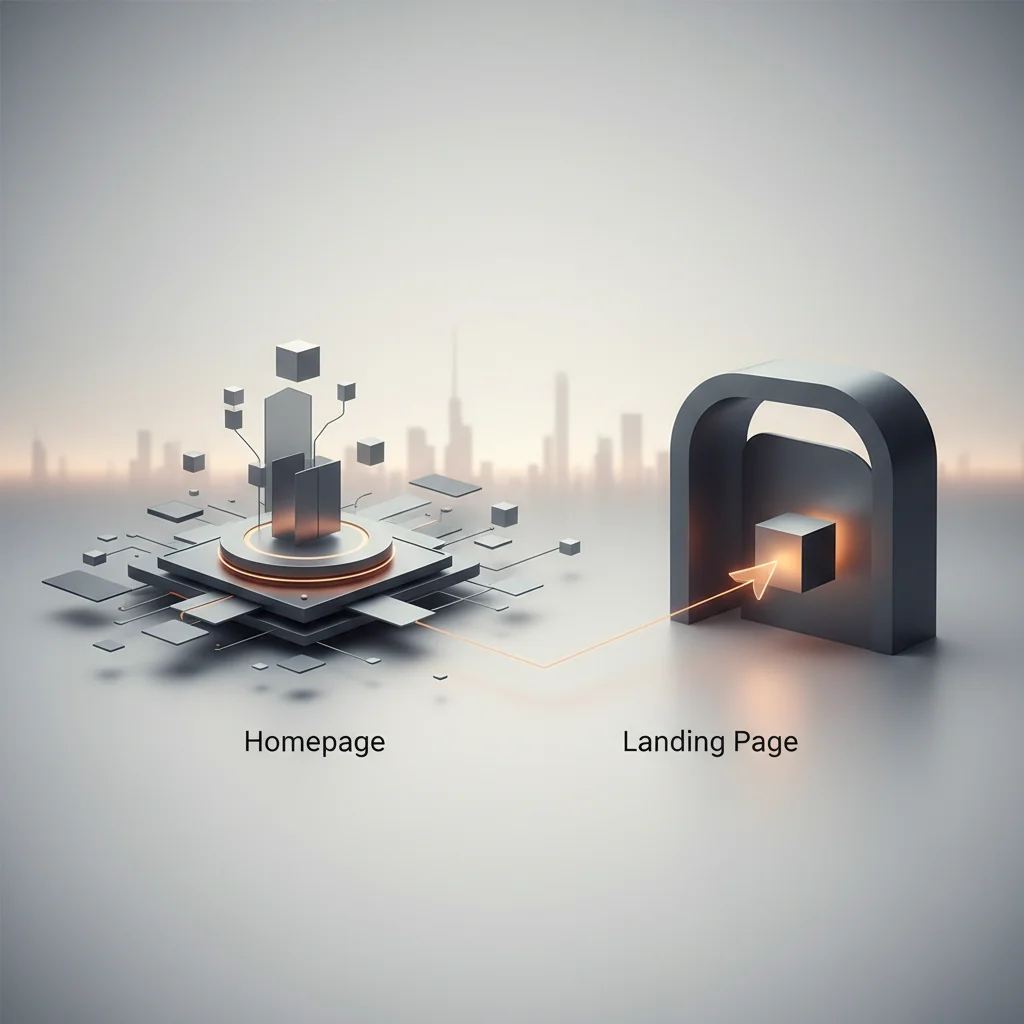
A homepage serves as a comprehensive website hub for navigation, while a landing page is designed for a single conversion goal and specific campaign traffic.
ON THIS PAGE
0% read
- The Core Distinction: Exploration vs. Conversion
- Defining the Homepage: Your Digital Storefront
- Defining the Landing Page: The Conversion Engine
- Head-to-Head Comparison: Landing Page vs. Homepage
- Strategic Application: When to Use Which Asset
- Costly Mistakes to Avoid in Page Strategy
- Conclusion: Aligning Your Pages with Your Business Goals
When designing a digital presence, businesses often conflate two fundamental assets: the homepage and the landing page. While both occupy space on the same domain, their architectural purposes, user journeys, and conversion structures are completely different. A homepage serves as a comprehensive website hub for navigation, while a landing page is designed for a single conversion goal and specific campaign traffic. Understanding the division between these assets is not just an aesthetic design choice; it is a critical business strategy. Misallocating traffic between them directly undermines advertising budgets, inflates bounce rates, and damages brand perception. This guide explores the engineering, psychological, and financial differences to help decision-makers optimize their online conversions.
The Core Distinction: Exploration vs. Conversion

The architectural philosophy of web design divides digital spaces into discovery-driven hubs and action-driven vectors. At the heart of this division lies user intent. A visitor arriving at a corporate website is rarely on a single, linear trajectory; they may be checking job openings, seeking press releases, examining pricing structures, or verifying company credentials. The homepage must act as a broad navigational portal to serve all these intents simultaneously without causing cognitive overload. It functions as a multidirectional digital directory, guiding different users to their respective destinations.
Conversely, a landing page is engineered around behavioral containment. It acts not as a directory, but as a destination. When a user arrives on a landing page, they do so via a targeted referral—typically a paid advertisement, an email newsletter, or a highly specific search engine query. The landing page assumes a singular, well-defined intent. Its structural job is to align with that intent and guide the visitor toward a single call to action (CTA), such as filling out a lead capture form or completing a purchase. There are no secondary escape routes, no broad informational menus, and no links to external resources that could divert user attention.
This operational distinction impacts the visual design, information density, and technical infrastructure of each asset. While a homepage distributes attention across multiple links and content blocks to encourage deep exploration, a landing page consolidates attention. By analyzing user behavior metrics, digital strategists observe that homepages encourage longer session durations and multiple page views per session, whereas landing pages prioritize higher, immediate actions on a single page, resulting in shorter session durations but exponentially higher conversion rates for targeted campaigns.
The Cost of Confusion: Why Mixing Them Up Drains Ad Spend
Deploying paid advertising campaigns without separating the destinations of your traffic causes measurable financial losses. When an organization runs a paid search or social campaign targeting a specific product, service, or offer, the user expects to see that exact offer immediately upon landing. If the ad link redirects to a generic homepage, the user is forced to search the global navigation menu, parse corporate overviews, and locate the product page manually. This friction triggers cognitive fatigue, causing the visitor to leave and increasing the bounce rate.
From a technical SEO and PPC management standpoint, directing paid traffic to a homepage penalizes campaign performance metrics. Modern advertising algorithms, such as Google Ads and Meta Ads, evaluate landing page experience as a core component of overall ad quality scores. A generic homepage lacks the contextual alignment, specific keyword density, and transactional focus required to score highly for targeted search queries. Low quality scores directly inflate the cost-per-click (CPC) and reduce ad rank, forcing businesses to spend more money for fewer, lower-quality impressions.
Furthermore, tracking attribution becomes difficult when conversion paths are cluttered. When a homepage is used as an ad destination, analytical models struggle to isolate which design elements, content blocks, or traffic sources triggered a conversion. On a dedicated landing page, conversion rate optimization (CRO) testing is clear. Because the page is isolated from the rest of the site architecture, marketing teams can easily attribute conversions directly to the paid campaign, providing clean data for accurate calculations of return on investment (ROI).
Defining the Homepage: Your Digital Storefront

The homepage represents the primary digital gateway of an organization. It is the virtual equivalent of a corporate headquarters lobby or a main street storefront. It is built to establish brand identity, state the core value proposition, prove credibility, and distribute traffic across the broader site architecture. Because it must satisfy diverse audiences, its design is necessarily broad and inclusive. The homepage accommodates prospective customers, recurring clients, job applicants, media representatives, and industry partners, providing each group with clear starting points for their specific journeys.
Technically, the homepage resides at the root domain of a web hosting architecture (e.g., company.com). It functions as the central node of the site's internal linking structure, distributing search engine authority (link equity) across lower-level subpages, blog posts, and service listings. A well-engineered homepage balances high-level content blocks with structured schema markup, signaling to search engine crawlers the site's overall topical authority, ownership details, and architectural layout.
Primary Objective: Brand Awareness and Navigation | Traffic Sources: Organic Search and Direct Traffic | Key Elements of an Effective Homepage
The primary objective of a homepage is to answer three fundamental questions within the first three seconds of a user's visit: who you are, what problems you solve, and where the user should go next. It accomplishes this through structured visual hierarchy, starting with an above-the-fold hero section containing a high-level value proposition. It does not try to close a transaction immediately; instead, it invites engagement, builds trust, and directs users to specialized subpages where the transaction can safely occur.
The traffic profile of a homepage is dominated by organic search and direct traffic. Users arriving via organic search typically search for brand terms (e.g., "Webizm services") or broad informational keywords. Direct traffic consists of returning visitors, existing clients, or offline leads typing the URL directly into their browsers. These visitors already have some familiarity with the brand, making the homepage’s role one of verification, support, and deep educational discovery rather than direct, cold conversion.
To satisfy this diverse audience while maintaining technical performance, an effective homepage must integrate several critical UI/UX and technical elements:
Global Navigation Menu: An intuitive, accessible main menu (often utilizing a mega-menu format for enterprise sites) that categorizes content by user intent and product lines.
Search Functionality: An easily accessible, predictive site-search bar to assist users who prefer direct query navigation over manual link browsing.
Trust and Authority Signals: Corporate milestones, client logos, security certifications, and industry award badges that validate the organization's credibility.
Dynamic Content Hubs: Curated sections displaying recent blog posts, news releases, or product updates, showing that the company is active and engaged.
Compliance and Legal Infrastructure: A comprehensive site footer featuring links to privacy policies, terms of service, cookie consent settings, and accessibility disclosures (such as WCAG compliance links).
Defining the Landing Page: The Conversion Engine
A landing page is a standalone digital page engineered specifically to support marketing, advertising, or sales campaigns. Unlike a homepage, which invites exploration, a landing page is built to restrict choice. Its primary design goal is conversion rate optimization (CRO). Every design asset—from the visual hero element to the text, layout, and loading speed—is chosen to guide the user toward a single, specific goal. By removing distractions and alternative navigation options, landing pages help reduce choice anxiety and make it easy for users to take action.
Technically, landing pages are often hosted on subdomains (e.g., @@CODE0@@) or isolated subfolders (e.g., @@CODE1@@). They are designed to sit outside the site’s main informational architecture. To protect campaign integrity, landing pages often employ search engine directives like @@CODE2@@ and @@CODE3@@ to prevent organic crawler indexing. This ensures the page is only reached by targeted paid traffic, keeping conversion data clean.
Primary Objective: Singular Call to Action (CTA) | Traffic Sources: Paid Campaigns and Targeted Ads | The Rule of One: Eliminating Distractions
The primary objective of a landing page is to convert a visitor into a lead or a customer. This conversion is driven by a singular Call to Action (CTA). Whether the target action is downloading a technical whitepaper, subscribing to a software-as-a-service (SaaS) trial, registering for an executive webinar, or purchasing a specific physical product, the entire page copy works together to support that single outcome. A landing page does not present multiple offers, nor does it ask the user to make complex decisions; it asks them to take one specific step.
The traffic profile of a landing page is highly targeted, coming almost entirely from paid campaigns and segmented promotional channels. This includes pay-per-click (PPC) search engine campaigns, paid social media advertising, targeted retargeting sequences, programmatic display networks, and customized email marketing campaigns. Because this traffic is acquired at a direct cost, the landing page is designed to convert these visitors efficiently to maximize the return on ad spend (ROAS).
To achieve maximum conversion rates, professional landing pages adhere strictly to the "Rule of One":
One Clear Audience: The page copy is tailored to a specific audience segment, addressing their direct pain points and matching the messaging of the ad that brought them there.
One Main Value Proposition: A focused headline and supporting copy that articulates a single benefit or solution without confusing alternative use cases.
One Primary Call to Action: A high-contrast, visually prominent CTA button supported by an optimized form that asks only for essential user information.
Zero Escape Routes: The absolute removal of the global site navigation menu, footer directories, social media feed widgets, and internal links. This design element ensures that the user's only options are to convert or exit.
This architectural isolation leverages the psychological concept of attention ratio. On a standard homepage, the attention ratio (the ratio of interactive links to conversion goals) is typically 40:1 or higher. On a high-performing landing page, the attention ratio is maintained at 1:1, meaning there is only one clickable target on the entire screen—the CTA button.
Head-to-Head Comparison: Landing Page vs. Homepage
To build a high-performing digital ecosystem, you need to understand the structural, behavioral, and analytical differences between homepages and landing pages. While a homepage supports brand discovery, search engine optimization (SEO), and general navigation, a landing page is built to capture highly targeted traffic and drive immediate conversions.
Evaluating these assets across core digital metrics highlights how their distinct design philosophies serve different business goals:
Audience Intent: Browsers vs. Buyers | Link Ratio: The Danger of Too Many Options | Conversion Rate Expectations
The differences between homepages and landing pages are defined by the psychological state of their visitors, their navigational freedom, and their expected conversion performance:
Audience Intent (Browsers vs. Buyers): Homepage visitors are typically "browsers" who have reached the site through organic searches, corporate referrals, or direct brand searches. They may be researching your company, looking for customer support, or looking for general resources. Their intent is informational. Landing page visitors, however, are typically "buyers." Guided by targeted advertising, they have already demonstrated a specific need by clicking on a contextual ad. They arrive with transactional or commercial intent, looking for a direct solution to a specific problem.
Link Ratio (The Danger of Too Many Options): The global navigation on a homepage can lead to choice overload. When presented with dozens of links (e.g., "About Us," "Services," "Blog," "Careers," "Contact"), visitors are highly likely to click around, get distracted, and leave without converting. This is known as Hick's Law: the time it takes to make a decision increases with the number and complexity of choices. Landing pages limit choices by removing standard navigation. This direct focus guides the user's path, minimizing cognitive friction and keeping attention on the conversion goal.
Conversion Rate Expectations: Because homepages cater to diverse, exploratory audiences, their average conversion rate typically ranges between 1% and 3%. A highly optimized landing page, designed for a single audience with clear intent, regularly achieves conversion rates between 5% and 15%, with elite B2B and SaaS landing pages often exceeding 20%.
Analytical breakdown of architectural, performance, and functional performance metrics. Avantaj 1:1 ratio. Only one clickable target designed to maximize CTA interaction. Dezavantaj High ratio (usually 40:1+). Diverse navigational paths dilute focus. Avantaj Targeted ad spend, paid advertising campaigns, email marketing segmentations. Dezavantaj Broad organic search traffic, direct brand traffic, corporate backlinks. Avantaj Single conversions (lead generation, downloads, registrations, demo bookings). Dezavantaj Discovery, information exploration, customer support routing, employer branding.Landing Page vs. Homepage Structural Comparison
Attention Ratio
Traffic Source
Primary UX Goal
Strategic Application: When to Use Which Asset

Maximizing your digital ROI requires a clear traffic routing strategy. Using the wrong asset for a campaign—such as sending paid traffic to a homepage or broad organic traffic to a highly restricted landing page—can hurt your brand's search visibility and waste ad spend. A high-performing digital strategy uses both assets, matching the user's location in the sales funnel with the correct page architecture.
Strategic traffic routing depends on where the user is in the marketing funnel:
Top of the Funnel (TOFU - Awareness): Broad organic search, direct brand exploration, PR campaigns, and organic social media reach. These channels represent informational search intent and are best directed to the Homepage or educational content hubs.
Middle of the Funnel (MOFU - Consideration): Users comparing specific solutions, reading industry whitepapers, or registering for educational webinars. This intent is best served by a dedicated Landing Page offering a helpful resource in exchange for contact information.
Bottom of the Funnel (BOFU - Decision): High-intent paid search ads, product-specific social ads, retargeting sequences, and direct email offers. This traffic is highly transactional and should always be directed to a dedicated Landing Page with a strong, single call to action.
Scenarios Demanding a Homepage
A homepage is the correct strategic destination when the primary goal is brand education, broad organic search authority, or serving multiple audiences at once. These scenarios require the full breadth of a site's architecture:
Brand Search and Direct Discovery: When a user searches for your brand name or types your root domain directly into their browser, they want a complete overview of your company, leadership team, values, and offerings. A homepage provides this context while establishing institutional trust.
SEO Domain Authority and Content Marketing: Building long-term search visibility requires a strong internal linking structure. The homepage acts as the main authority hub, distributing search equity to blog posts, resources, and product pages.
Multi-Audience Hubs (Enterprise & Corporate portals): If your business serves multiple audiences—such as partners, job candidates, media, and clients—the homepage is the logical hub to organize these separate user journeys.
Critical Campaigns That Require a Dedicated Landing Page
A dedicated landing page is essential when you are spending budget on paid traffic or running campaigns targeting a specific, measurable conversion goal:
Pay-Per-Click (PPC) Search engine marketing: Running Google Ads targeting high-commercial-intent keywords (e.g., "enterprise CRM software solutions") requires a landing page that matches the search query. This maintains a strong ad Quality Score, reduces cost per acquisition, and increases conversion rates.
Paid Social Advertising: Visual campaigns on platforms like Meta, LinkedIn, or YouTube need to direct users to a matching page. If the ad promises a 20% discount on a specific product line, the landing page must display that exact offer above the fold without distracting navigation.
Lead Generation Lead Magnet Campaigns: When offering high-value downloadable resources like whitepapers, tools, or templates, a landing page is crucial to secure the contact information of prospective buyers.
Product Launches and Event Registrations: Promoting a specific product launch or webinar requires a focused registration page. Removing external site navigation keeps visitors focused on the registration form, maximizing sign-ups.
Choose the optimal layout style based on campaign goals and user targeting parameters. Avantaj Landing page is mandatory to maintain a high Quality Score and capture specific intents. Dezavantaj Avoid homepage; generic navigation results in severe ad spend wastage. Avantaj Homepage provides comprehensive background, leadership profiles, and corporate disclosures. Dezavantaj Landing page is too narrow and fails to establish broad organizational credibility. Avantaj Homepage structured with robust SEO hierarchy targets high-volume generic keywords. Dezavantaj Landing page is structurally too lean to support a broad topical authority framework.Decision Matrix: Selecting Your Digital Asset
PPC Lead Generation Campaign
Institutional Trust & PR
Organic Broad Industry Search
Costly Mistakes to Avoid in Page Strategy
Misallocating digital resources or using poor layout practices can hurt your conversion rates and waste marketing budgets. Many organizations spend substantial sums on paid advertising, only to direct high-intent traffic to pages that confuse visitors and increase bounce rates. Recognizing and fixing these common design errors can improve your return on ad spend (ROAS) and create a smoother user experience.
These issues are often structural, stemming from a lack of alignment between marketing campaigns and web architecture:
Treating the Homepage as a Landing Page: Attempting to force a single homepage to act as a focused conversion funnel for every paid campaign often results in a cluttered layout that fails to convert targeted traffic.
Neglecting Mobile Optimization: Building pages that perform well on desktop but load slowly or display poorly on mobile devices can cause you to lose high-intent traffic.
Inconsistent Message Match: Creating a disconnect between the copy in your advertisements and the headlines on your landing pages can break trust and cause visitors to leave immediately.
Directing Paid Traffic to a Homepage
Directing paid traffic from Google Ads, LinkedIn Ads, or Meta Campaigns to a homepage is one of the most common causes of wasted ad spend. When a user clicks a paid ad, they expect to see the specific product or offer promised in the ad. If they are redirected to a generic homepage, they must navigate the site to find it. This cognitive friction often leads to an immediate bounce, raising your cost-per-lead (CPL) and reducing campaign performance.
Furthermore, this practice can lower your Quality Score on platforms like Google Ads. Search engine advertising algorithms evaluate landing page relevance as a core ranking factor. A homepage, which typically contains a mix of brand messages, recruitment links, and general information, lacks the specific keyword density and direct conversion layout needed to rank highly for targeted queries. This can lead to lower ad positions and higher costs per click.
Overcrowding a Landing Page with Navigation Links
Removing the global navigation menu from a landing page is a proven conversion rate optimization (CRO) practice. Despite this, some businesses still include standard headers, footers, and social media links on their landing pages. These links act as exit points, giving visitors easy ways to leave the page before completing the primary call to action (CTA).
Every external link on a landing page increases the risk of distraction. If a visitor clicks a footer link to read your corporate blog or visits your Twitter profile through a social widget, they are unlikely to return and complete the conversion form. To maintain a strong 1:1 attention ratio, keep your landing pages free from non-essential links, keeping the focus entirely on your conversion goal.
Misaligning Ad Copy with Page Content
A strong "message match" is essential for successful paid campaigns. Message match refers to how closely the headline, value proposition, and visual style of your landing page align with the ad that referred the visitor. If an ad promises "Enterprise Cybersecurity Audits with 24-Hour Delivery" but the landing page headline reads "Comprehensive Digital IT Infrastructure Protection," the user experiences cognitive dissonance. They may feel they clicked the wrong link, leading to an immediate bounce.
To ensure a strong message match:
Align Headlines and Ad Copy: Ensure your landing page headline closely mirrors the key value proposition of your top-performing ads.
Maintain Visual Consistency: Use consistent brand colors, fonts, and imagery across both your ad creatives and your landing page.
Sync Special Offers: If your ad mentions a specific discount, trial period, or resource, make sure that exact offer is clearly visible above the fold on your landing page.
Conclusion: Aligning Your Pages with Your Business Goals
Designing a high-performing digital presence requires a clear understanding of the roles of both homepages and landing pages. Rather than competing assets, they are complementary parts of a successful digital strategy. A homepage serves as your brand's central digital hub, establishing credibility and supporting organic search discovery for broad audiences. Meanwhile, landing pages act as focused conversion engines, designed to turn targeted paid traffic into active leads and customers.
Optimizing both assets involves aligning your technical architecture and design choices with clear business objectives. By ensuring your homepage is structured for intuitive navigation and your landing pages are isolated and optimized for single conversions, you can reduce user friction and improve campaign performance. Balancing discovery-driven design with action-focused conversion funnels is a proven way to support long-term search visibility and maximize your return on marketing investments.
Frequently Asked Questions
Can my homepage serve as a landing page?
A homepage can technically serve as a landing page, but it is highly inefficient for paid campaigns because its multiple links and broad messaging distract visitors and lower conversion rates.
Do landing pages require SEO optimization?
Landing pages built for paid campaigns are often set to "noindex" to keep data clean, but SEO landing pages targeting specific, high-intent keywords can rank well and generate valuable organic conversions.
How many landing pages does a corporate website need?
There is no set number, but businesses targeting multiple audience segments, running different paid search campaigns, or promoting various resources should build dedicated landing pages for each offer to improve conversion rates.
What is the ideal landing page conversion rate compared to a homepage?
Homepage conversion rates typically average 1% to 3%, whereas well-optimized landing pages regularly achieve conversion rates between 5% and 15%, with high-performing pages exceeding 20%.
Should a landing page have a navigation menu?
No, a landing page should not include a global navigation menu. Removing header and footer menus keeps visitors focused on the primary call to action and reduces exit paths.
How does page speed impact landing page performance versus homepages?
Page speed is critical for both, but a slow-loading landing page directly wastes paid ad spend by increasing bounce rates before visitors even see your offer.
Can you run paid campaigns directly to a subdomain landing page?
Yes, hosting landing pages on subdomains like promo.company.com is a standard practice that allows marketing teams to build and deploy pages without altering the main website architecture.
What is message match and why is it crucial for paid campaigns?
Message match is the alignment between your ad copy and your landing page headline. Strong message match reduces cognitive friction, builds trust, and helps lower bounce rates.