
What Is End-to-End Encryption?
End-to-end encryption (E2EE) is a secure communication method preventing third-party access to data during transfer. Only communicating users can decrypt messages.
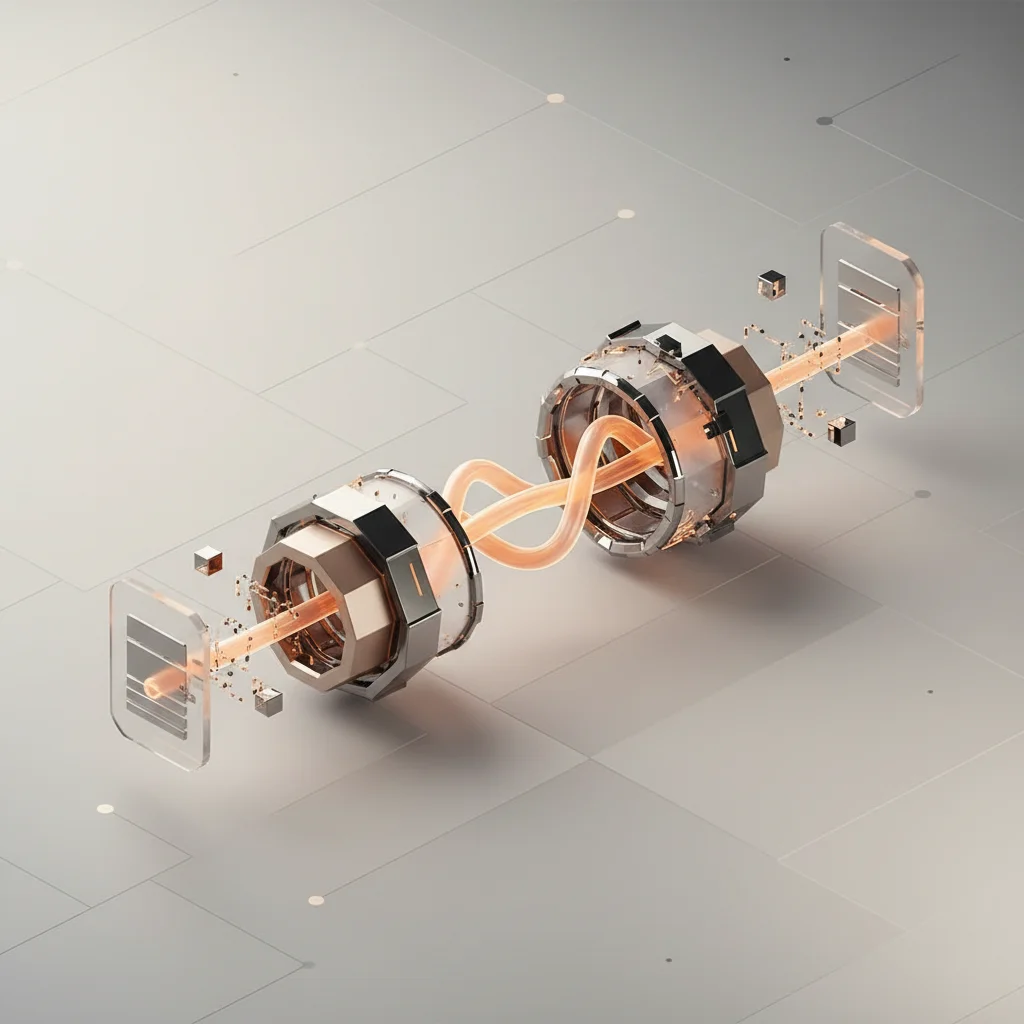
End-to-end encryption (E2EE) is a secure communication method preventing third-party access to data during transfer. Only communicating users can decrypt messages.
When evaluating enterprise communication architecture, understanding what is end-to-end encryption (E2EE) serves as the baseline for safeguarding corporate intellectual property, customer data, and internal communications. Traditional encryption models protect data only while moving between a client and a central server, leaving information exposed to server-side inspection, interception, or insider threats. This guide analyzes how E2EE operates at a cryptographic level, contrasts it with transit encryption, breaks down its core business applications, and outlines the operational limitations IT leaders and security officers must address.
Understanding End-to-End Encryption: The Core Definition
End-to-end encryption represents a paradigm where cryptographic operations are executed strictly at the logical boundaries of communication—the endpoints. In this model, data is encrypted on the sender's device (the originating client) and remains in an encrypted state throughout its entire traversal across local networks, internet service providers (ISPs), routing infrastructure, and application servers. Decryption occurs exclusively on the designated recipient's device.
Under an E2EE implementation, the service provider operating the communication infrastructure acts solely as a blind transport relay. The application servers receive, route, and deliver payloads composed entirely of ciphertext. Because the service operator does not possess or manage the corresponding private keys required for decryption, neither infrastructure engineers, cloud hosting providers, nor malicious actors compromising the server infrastructure can access the underlying plaintext.
This architecture enforces zero-trust principles in transit. Traditional trust models assume that central infrastructure is secure and that service providers can be trusted to handle plaintext during processing. E2EE eliminates this assumption, mathematically verifying that unauthorized interception along the delivery path yields zero actionable intelligence.
How E2EE Protects Data During Transfer
Data protection during transfer relies on the cryptographic decoupling of data transport from data access. When a payload—whether a chat message, file attachment, database backup, or video stream—is queued for transmission, the client application invokes local cryptographic libraries to convert the plaintext into ciphertext using standard cryptographic algorithms.
[Sender Endpoint] ────(Plaintext encrypted to Ciphertext)────┐
                                                            │
[ISP / Public Internet] ───(Inaccessible Ciphertext)────────┼──► [Recipient Endpoint]
                                                            │    (Ciphertext decrypted to Plaintext)
[Cloud / Application Server] ──(Blind Transit Relay)────────┘
During the physical and logical transit phases:
Network Boundary: The local operating system transmits packets containing unreadable ciphertext over local area networks (LANs) and public wide area networks (WANs).
Intermediate Routing: Routers, switches, and deep packet inspection (DPI) appliances can inspect transport-layer headers (such as IP addresses and ports), but the payload remains cryptographically opaque.
Application Server Relay: The central server receives the payload, inspects routing metadata to identify the target recipient, and forwards the ciphertext without decrypting the content.
Endpoint Decryption: The target client retrieves the ciphertext from its local buffer, applies its private key, and reconstructs the original plaintext.
This continuous protection mechanism neutralizes classic surveillance vectors, unauthorized data exfiltration at hosting facilities, and rogue administrator access.
E2EE vs. Encryption-in-Transit: What Is the Difference?
A common architectural misconception is conflating standard encryption-in-transit (such as Transport Layer Security / TLS 1.3) with true end-to-end encryption. While both use robust cryptographic primitives, their boundary terminations and trust perimeters differ fundamentally.
In a standard TLS deployment, communication is encrypted between Client A and the Server, decrypted into plaintext on the Server for processing or business logic execution, and then re-encrypted under a separate TLS session between the Server and Client B. A breach of the central application infrastructure exposes all transient plaintext. In an E2EE deployment, no intermediate decryption occurs.
---
How Does End-to-End Encryption Work?
Modern end-to-end encryption systems combine symmetric encryption and asymmetric cryptography into a hybrid system. This approach balances cryptographic speed with secure key distribution.
Direct asymmetric encryption (such as pure RSA) is computationally intensive and inefficient for encrypting large data payloads or continuous media streams. Consequently, enterprise E2EE architectures use asymmetric algorithms to establish a shared secret or exchange an ephemeral symmetric key. Fast symmetric algorithms then handle the bulk data payload.
The Role of Asymmetric Cryptography
Asymmetric cryptography, or public-key cryptography, uses mathematically linked key pairs: a public key and a private key. The public key is distributed openly across directory servers or public key infrastructure (PKI) frameworks, while the private key is generated locally and stored inside client-side secure enclaves or cryptographic keyrings.
Common asymmetric algorithms and key-exchange protocols include:
Elliptic Curve Cryptography (ECC): Algorithms like Curve25519 and Ed25519 provide high cryptographic strength with shorter key lengths (e.g., a 256-bit ECC key offers comparable security to a 3072-bit RSA key), reducing computational overhead on mobile and edge devices.
Diffie-Hellman Key Exchange (ECDH): Elliptic Curve Diffie-Hellman allows two parties with no prior shared secrets to establish a mutual encryption key over an insecure channel.
RSA (Rivest–Shamir–Adleman): Legacy implementations use RSA-2048 or RSA-4096 for key encapsulation, though modern protocols increasingly favor ECC.
Public Keys, Private Keys, and the Decryption Process
The transformation from plaintext to ciphertext and back follows a strict mathematical pipeline:
Key Generation: When a user registers an endpoint device, the client application generates an asymmetric key pair:
$$\text{Key Pair} = \{K{\text{public}}, K{\text{private}}\}$$
$K{\text{public}}$ is uploaded to the central user directory server, while $K{\text{private}}$ remains locked inside the device's Secure Enclave, KeyStore, or Trusted Platform Module (TPM).
Session Key Negotiation: When User A initiates a communication channel with User B, User A’s client fetches User B’s verified $K{\text{public}}$ from the directory. User A’s client generates a cryptographically random, ephemeral symmetric key ($K{\text{session}}$) using an algorithm such as AES-256-GCM or ChaCha20-Poly1305.
Hybrid Packaging:
The bulk message ($M$) is encrypted with the symmetric session key:
$$C{\text{payload}} = \text{Encrypt}{\text{AES}}(M, K_{\text{session}})$$
The session key is encrypted with User B's public key:
$$C{\text{key}} = \text{Encrypt}{\text{ECC}}(K{\text{session}}, K{\text{public\_B}})$$
The combined transmission payload is packaged:
$$\text{Payload} = \{C{\text{payload}}, C{\text{key}}\}$$
Decryption on Target Client: User B receives the package from the relay server. User B's client uses its locally stored $K{\text{private\B}}$ to decrypt $C{\text{key}}$, recovering $K{\text{session}}$. Finally, $K{\text{session}}$ decrypts $C{\text{payload}}$ to reproduce the original plaintext $M$.
Modern protocols, such as the Signal Protocol (Double Ratchet Algorithm), continuously rotate session keys with every exchanged message. This mechanism establishes Perfect Forward Secrecy (PFS) and Post-Compromise Security (PCS). If a private session key is compromised at a specific point in time, past messages and future communications remain cryptographically protected.
Real-World Example: Sending a Secure Message
To illustrate this process in an enterprise context, consider a financial analyst (User A) sending confidential quarterly revenue figures to a compliance officer (User B) over an E2EE messaging platform.
+-----------------------------------------------------------------------------------+
| 1. User A compiles plaintext: "Q3 Margin: +14.2%"                                 |
| 2. User A client generates random 256-bit symmetric key (K_session)               |
| 3. User A client encrypts text with K_session -> Ciphertext                       |
| 4. User A client retrieves User B Public Key -> Encrypts K_session                |
| 5. Package dispatched through corporate relay server (Server sees raw ciphertext) |
| 6. User B client receives package -> Applies User B Private Key to unwrap K_session|
| 7. K_session decrypts Ciphertext -> User B reads plaintext: "Q3 Margin: +14.2%"   |
+-----------------------------------------------------------------------------------+
Throughout this exchange, the corporate relay server logs connection timestamps, IP addresses, and encrypted blobs. If an adversary gains administrative root access to that relay server during transit, they obtain only unreadable ciphertext.
---
The Critical Benefits of E2EE for Corporate Security
Deploying end-to-end encryption directly addresses systemic enterprise security vulnerabilities. As organizations adopt hybrid work environments and multi-tenant cloud ecosystems, traditional perimeter-based security models are no longer sufficient. E2EE enforces a data-centric security architecture that limits data exposure even when physical hardware or cloud services are compromised.
Mitigating the Risk of Data Breaches
In a standard centralized architecture, the application database and file storage systems hold unencrypted customer data, intellectual property, and internal records. A successful SQL injection, remote code execution (RCE), or compromised administrative credential can lead to massive data exfiltration.
With E2EE implemented at the application layer:
Server-Side Data Storage Is Inert: Stored database records consist of encrypted blobs. Without client private keys, an attacker exfiltrating the entire database gains no readable data.
Insider Threat Neutralization: Rogue systems administrators, cloud hosting personnel, or third-party maintenance contractors cannot access customer or corporate data.
Blast Radius Reduction: A security breach affecting central infrastructure does not automatically result in a catastrophic data privacy event.
Protection Against Man-in-the-Middle (MitM) Attacks
Man-in-the-Middle (MitM) attacks occur when an adversary intercepts, alters, or injects traffic between communicating parties. In corporate environments, MitM threats typically stem from:
Rogue Wi-Fi access points in public venues or remote offices.
Compromised local DNS servers or Address Resolution Protocol (ARP) spoofing.
Malicious or compromised Certificate Authorities (CAs) issuing fraudulent TLS certificates to decrypt HTTPS streams.
Because E2EE establishes cryptographic trust directly between endpoints, intermediary network nodes cannot forge or tamper with the payload without invalidating the cryptographic signatures. Even if an attacker controls a network proxy or manipulates TLS certificates, the payload remains protected by the recipient's public key. Any modification to the ciphertext during transit breaks the integrity verification (e.g., via HMAC or authenticated ciphers like AES-GCM), causing the receiving client to reject the payload.
Ensuring Regulatory Compliance and Data Privacy
E2EE helps organizations align with strict international data protection mandates and industry standards:
General Data Protection Regulation (GDPR - Article 32): Mandates the implementation of appropriate technical and organizational measures to ensure security appropriate to the risk, explicitly citing encryption of personal data. Under GDPR Recital 83 and Article 34, if breached data is cryptographically protected with state-of-the-art encryption, it is considered unintelligible to unauthorized parties, often eliminating the requirement to notify affected individuals.
Health Insurance Portability and Accountability Act (HIPAA): Requires covered entities to safeguard Electronic Protected Health Information (ePHI). E2EE guarantees that healthcare data shared between practitioners and patients cannot be intercepted across third-party communication channels.
ISO/IEC 27001 (Control A.10 / ISO 27002:2022 Control 8.24): Specifies clear rules for the effective use of cryptography to protect data confidentiality, integrity, and authenticity.
---
Security Blind Spots: The Limitations of End-to-End Encryption
While end-to-end encryption provides strong mathematical protections for data in transit, it is not a comprehensive security solution on its own. IT directors and security architects must recognize where E2EE protections end. Treating E2EE as an absolute defense often leads to architectural blind spots, particularly regarding endpoint security, metadata leakage, and secondary data synchronization.
Endpoint Vulnerabilities: Malware, Keyloggers, and Compromised Devices
E2EE protects data between endpoints, not on endpoints. Once ciphertext arrives at the destination device and is decrypted into plaintext, it resides in system memory (RAM) and is displayed on the user interface.
If the physical endpoint is compromised:
Keyloggers and Screen Scrapers: Infostealers and commercial spyware capture keystrokes and take screen captures before data is encrypted or after it is decrypted.
Operating System Exploits: Zero-day vulnerabilities (e.g., targeting iOS or Android frameworks) allow attackers with root or kernel-level access to dump process memory, extracting private cryptographic keys or reading plain message buffers directly.
Physical Device Theft: An unlocked or poorly authenticated device allows unauthorized parties to view decrypted message stores directly through the client application.
Implementing E2EE without accompanying Endpoint Detection and Response (EDR), Mobile Device Management (MDM), and hardware-level isolation (such as Secure Enclaves) leaves the communication channel open to attacks at the terminal points.
The Threat of Metadata Exposure
E2EE encrypts payload content, but it cannot hide the metadata required to route and process network traffic. Network observers, service operators, and surveillance systems can analyze this structural communication data:
+-------------------------------------------------------------+
| UNENCRYPTED METADATA (Visible to Routers, ISPs, & Servers)  |
| - Sender IP Address & Geolocation                           |
| - Recipient IP Address / User Identifier                   |
| - Exact Timestamps and Frequency of Communication           |
| - Size of Data Payloads and Burst Patterns                  |
+-------------------------------------------------------------+
| ENCRYPTED PAYLOAD (Protected by E2EE)                       |
| - Message Content, Files, Voice Streams, Images             |
+-------------------------------------------------------------+
Using traffic analysis, adversaries can establish communication graphs, map corporate organizational hierarchies, identify whistleblowers, and correlate operational events (such as M&A negotiations or litigation preparations) purely from message volume, timing, and participant identities.
Cloud Backup Risks: Is Your Stored Data Still Encrypted?
A common corporate configuration error involves unencrypted cloud backups of E2EE application databases.
Many consumer and enterprise messaging platforms store conversation history in an E2EE state on the device. However, when users enable standard operating system backups (such as Google Drive or standard Apple iCloud backups), the local database—often containing decrypted message history or the private decryption keys—is copied to a cloud server.
Unless these cloud backups are explicitly configured with independent client-side encryption, the cloud provider holds the decryption keys. This negates the security advantages of E2EE by exposing historical message archives to server-side subpoenas, third-party data breaches, or compromised cloud credentials.
---
Common Applications of End-to-End Encryption in Business
Businesses handle sensitive information across multiple communication and storage platforms. Deploying targeted E2EE solutions helps protect trade secrets, board communications, human resources records, and legal correspondence from external exposure.
Secure Enterprise Messaging Platforms
Real-time collaboration tools are prime targets for corporate espionage and credential theft. Organizations handling sensitive data frequently deploy dedicated E2EE messaging environments.
Signal Protocol Implementations: Uses the Double Ratchet Algorithm, Prekeys, and Triple Diffie-Hellman (3DH) handshakes. Platforms like Signal and enterprise variants (such as Wire and Matrix/Element) apply this protocol to secure direct messages, group chats, voice calls, and video streams.
Ephemeral Messaging and Forward Secrecy: Advanced enterprise platforms enforce message self-destruction timers and cryptographic key rotation, preventing historical data recovery if a physical device is seized.
On-Premises / Federated Deployments: Protocols like Matrix allow enterprises to host their own homeservers while retaining E2EE across federated organizations, maintaining ownership of routing metadata.
Encrypted Email Services
Standard email infrastructure relies on Simple Mail Transfer Protocol (SMTP), which defaults to plaintext transmission unless upgraded via opportunistic TLS (STARTTLS). Even with TLS, emails sit in plaintext on mail servers across intermediate hops. E2EE email architectures resolve this design limitation.
S/MIME (Secure/Multipurpose Internet Mail Extensions): Relies on centralized Public Key Infrastructure (PKI) and digital certificates issued by trusted Certificate Authorities. S/MIME encrypts email bodies and attachments while digitally signing messages to ensure sender authenticity and non-repudiation. It is widely supported across Microsoft Outlook, Apple Mail, and enterprise email clients.
PGP / OpenPGP (Pretty Good Privacy): Uses a decentralized Web of Trust (or managed internal keyrings) for key distribution. OpenPGP provides strong cryptographic privacy for technical and developer-focused teams.
Zero-Knowledge Webmail Providers: Services such as ProtonMail and Tuta integrate automated PGP key handling within browser and mobile clients, performing cryptographic operations locally via JavaScript or native code.
Secure Cloud Storage and File Sharing
Traditional cloud storage vendors maintain server-side encryption keys, allowing them to access, index, and process customer files for thumbnails, search, or compliance requests. Conversely, Zero-Knowledge / E2EE Cloud Storage encrypts files locally on the client device prior to upload.
Key features of E2EE file storage systems include:
Client-Side File Chunking: Files are split into distinct blocks, each encrypted with unique symmetric keys before being transmitted to cloud buckets (e.g., AWS S3, Azure Blob).
Zero-Knowledge Key Derivation: The encryption keys are derived from user master passwords using key derivation functions like Argon2id or PBKDF2. The service provider never receives or stores the master password or unencrypted keys.
Secure Enterprise File Sharing: Platforms such as Tresorit, Sync.com, and AxCrypt allow enterprises to share encrypted files with external partners using client-side generated key exchange links.
---
Implementation Checklist and Strategic Considerations for Organizations
Integrating end-to-end encryption into enterprise operations requires balancing absolute data confidentiality with practical business requirements, such as auditability, legal discovery, and data loss prevention (DLP). Security teams must approach E2EE deployment with a structured methodology. Key Management and Zero-Knowledge Architecture The security of any cryptographic system depends directly on key management. Weak key generation, insecure key distribution, or unmanaged private key storage will undermine the protections of E2EE. Critical key management requirements include:
Entropy and Generation
Cryptographic keys must be generated using cryptographically secure pseudorandom number generators (CSPRNG).
Hardware-Backed Storage
On mobile and desktop endpoints, private keys should be bound to hardware security modules, such as Apple's Secure Enclave, Android's StrongBox, or PC TPM 2.0 chips.
Recovery Mechanisms
In a zero-knowledge architecture, if a user loses their private key and recovery phrase, their data cannot be recovered. Enterprises must deploy split-key recovery protocols (such as Shamir's Secret Sharing) or managed escrow solutions for corporate accounts to prevent permanent data loss upon employee departure.
Balancing Compliance Demands with E2EE
While E2EE solves many data protection challenges, it can complicate certain regulatory and compliance workflows:
FINRA / SEC Record-Keeping: Financial institutions are legally obligated to record and archive business-related communications. Pure, unmonitored E2EE consumer apps (like personal WhatsApp accounts) bypass compliance recording systems, resulting in severe regulatory fines. Enterprises in regulated sectors must deploy E2EE solutions that support authorized client-side compliance archiving or managed escrow keys.
Data Loss Prevention (DLP): Traditional network DLP tools inspect outgoing payloads at the perimeter firewall to block data exfiltration. Because E2EE payloads are unreadable ciphertext to network middleboxes, DLP checks must occur directly on the endpoint prior to encryption.
eDiscovery and Forensics: Legal holds and discovery orders require organizations to search and produce internal records. E2EE systems must support administrative eDiscovery protocols without compromising the underlying cryptographic architecture for active users.
Organizations must balance their threat model against their legal obligations, selecting E2EE architectures that provide strong data confidentiality while maintaining necessary operational compliance controls.
---
Frequently Asked Questions
Can end-to-end encryption be intercepted or broken?
Modern cryptographic algorithms like AES-256 and Curve25519 cannot be brute-forced with current computing technology. Interceptions target vulnerabilities at endpoints (such as malware, keyloggers, and compromised operating systems) or rely on poor key management rather than breaking the mathematical encryption itself.
What is the main difference between E2EE and standard TLS/HTTPS encryption?
Standard TLS/HTTPS encrypts data only between the user and the server, allowing the service provider to view and process plaintext data. End-to-end encryption ensures data remains encrypted on intermediary servers, allowing only the designated recipient's device to perform decryption.
Does end-to-end encryption protect my identity and metadata?
No, E2EE protects only the payload content of a message or file. Metadata, including sender and receiver IP addresses, message timestamps, payload sizes, and communication frequency, remains visible to network routers, internet providers, and server operators.
Can a company read employee messages if an E2EE messaging platform is used?
The central server operator cannot read E2EE messages during transit. However, if the company manages the endpoint device through Mobile Device Management (MDM) software or client-side compliance agents, they can access decrypted message data directly on the device.
What happens to encrypted data if a user loses their private key?
In a true zero-knowledge E2EE implementation, losing the private key and backup recovery phrases results in permanent, irrecoverable data loss. Service providers do not store private keys and cannot reset or recover decrypted data for the user.
Is end-to-end encryption compliant with GDPR and HIPAA standards?
Yes, E2EE aligns with both GDPR Article 32 and HIPAA technical safeguard requirements. By ensuring data cannot be read during a server breach, E2EE helps organizations meet their statutory obligations for safeguarding personal and health information.
Can law enforcement decrypt end-to-end encrypted messages from server backups?
Law enforcement cannot decrypt properly implemented E2EE ciphertext obtained from server seizures or subpoenas because the provider does not hold the keys. Instead, investigations focus on obtaining unencrypted local backups, seizing physical endpoints, or intercepting data directly on the target device.
Why do some communication platforms not use end-to-end encryption by default?
Implementing E2EE limits server-side features, such as full-text search indexing, server-side content moderation, automated spam filtering, and multi-device cloud synchronization. Many platforms choose standard transit encryption to preserve server-side functionality and monetization options.