
What Is RAG (Retrieval-Augmented Generation)?
Retrieval-Augmented Generation (RAG) is an AI framework that connects large language models to external knowledge bases, ensuring more accurate and up-to-date responses.

ON THIS PAGE
0% read
- Understanding the Limits of Traditional Large Language Models (LLMs)
- What Is Retrieval-Augmented Generation (RAG)?
- How Does RAG Work? The Core Architecture Explained
- Key Benefits of RAG for Enterprise AI Deployment
- RAG vs. Fine-Tuning: Which Approach Is Right for Your Business?
- Corporate Use Cases for Retrieval-Augmented Generation
- Challenges and Cautions When Implementing RAG
- Best Practices for a Secure RAG Integration
In the rapidly evolving landscape of enterprise artificial intelligence, business leaders and technical decision-makers frequently encounter the operational limitations of static language models. Retrieval-Augmented Generation (RAG) offers a highly structured mechanism to address these limitations by bridging the gap between generative capabilities and dynamic, proprietary data sources. This guide provides a comprehensive analysis of What Is RAG (Retrieval-Augmented Generation)?, exploring its technical architecture, practical business benefits, and integration strategies. Designed for corporate decision-makers and technical architects, this examination outlines how RAG enhances information retrieval, mitigates factual inaccuracies, and provides secure, scalable knowledge management across enterprise environments.
Understanding the Limits of Traditional Large Language Models (LLMs)

The Problem of Outdated Information in LLMs
Traditional Large Language Models (LLMs) operate on a foundational architecture that relies strictly on parametric knowledge. This knowledge is acquired during an intensive, resource-heavy pre-training phase, during which the model processes massive datasets to learn language patterns, semantic relationships, and general factual information. Once this training phase is finalized, the model’s internal weights are frozen. Consequently, the model becomes isolated from any events, developments, or new publications that occur after its cutoff date.
For enterprise applications, this temporal disconnect presents a severe operational risk. Market conditions, regulatory compliance standards, software documentation, and internal corporate data are subject to continuous modification. Relying on a static model to handle dynamic operational queries inevitably leads to obsolete guidance. For example, a model trained up to a certain point in time cannot assist a customer looking for the latest product specifications released yesterday, nor can it provide up-to-date compliance advice on financial regulations that were modified last month.
Attempting to solve this limitation by continuously retraining the foundational model is financially and logistically impractical for most organizations. Pre-training or even globally updating a model with billions of parameters requires specialized machine learning engineering teams, massive high-performance computing clusters, and substantial training durations. The financial footprint of such continuous training runs quickly spirals out of budget, making it an unsustainable approach for businesses requiring up-to-the-minute informational updates.
Addressing AI Hallucinations with External Knowledge
Another structural limitation of generative models is their tendency to experience AI hallucinations. Because generative models are designed to predict the next statistically probable word or token in a sequence rather than retrieve verified facts from an external source, they can generate highly fluent, grammatically flawless, yet completely incorrect answers. In a corporate environment, these hallucinations are not merely inconvenient; they can lead to flawed strategic decisions, legal liabilities, or damaged client relationships.
[User Query] ──> [Generative Model (Parametric Knowledge Only)] ──> [Hallucinated or Outdated Output]
                                      vs.
[User Query] ──> [Retrieval Engine] ──> [Relevant Chunks] ──> [LLM Context] ──> [Grounded Output]
To mitigate this behavior, systems must anchor the generative process in verified, external knowledge bases. This grounding mechanism acts as an open-book exam for the AI model. Instead of forcing the neural network to search through its vast, compressed parametric memory for specific factual details, an external information retrieval layer finds the exact, authoritative document containing the answer. This retrieved context is then supplied directly to the model along with the user's initial query.
By constraining the model’s generation process to a specific, verified set of reference materials, the probability of hallucinations is substantially reduced. The model is instructed to synthesize the retrieved text and base its response exclusively on those facts. If the retrieved documents do not contain the answer, the system can be configured to decline to answer rather than fabricate information, ensuring a level of auditability and trust necessary for corporate deployment.
What Is Retrieval-Augmented Generation (RAG)?

Defining RAG as an AI Framework, Not Just a Model
Retrieval-Augmented Generation (RAG) is not a standalone neural network architecture, nor is it a separate machine learning model. Instead, it is an architectural framework that orchestrates two distinct components of modern artificial intelligence: an information retrieval mechanism and a generative language model. First conceptualized by researchers in 2020, RAG decouples the factual knowledge base from the linguistic capability of the language model, creating a highly modular, adaptable system.
Under this framework, the Large Language Model functions primarily as a highly capable, natural language processing engine and interface. It retains its deep understanding of syntax, context, and reasoning patterns, but is no longer relied upon to act as the primary database of record. The database of record is moved outside the model’s weights and into an external, easily updated storage medium, such as a vector database or a document indexing system. This separation of concerns allows developers to manage, audit, and update the core data independently of the generative model.
Because the underlying AI model remains unchanged during this process, organizations can swap different models in and out of their RAG pipelines as new, more efficient, or cheaper options become available on the market. This protects the business against model lock-in and allows the infrastructure to adapt to evolving technological standards without requiring a complete re-engineering of the organizational data ingestion pipelines.
How RAG Enhances LLMs with Real-Time and Proprietary Data
The primary value proposition of a RAG framework is its ability to safely expose a generative model to real-time, proprietary, and highly sensitive organizational data. Enterprise operations run on highly confidential documents—such as internal code repositories, proprietary product designs, legal agreements, human resource policies, and customer journey histories—that cannot be shared with public model training sets due to strict data privacy regulations like GDPR and HIPAA.
┌────────────────────────────────────────────────────────┐
│                   Data Ingestion Pipeline              │
│                                                        │
│  [Proprietary Data Sources]                            │
│  (PDFs, Wikis, CRM, APIs)                              │
│             │                                          │
│             ▼                                          │
│  [Document Chunking]                                   │
│             │                                          │
│             ▼                                          │
│  [Vector Embedding Generator] (e.g., text-embedding)   │
│             │                                          │
│             ▼                                          │
│  [Vector Database Index] (Pinecone, Qdrant, Milvus)     │
└────────────────────────────────────────────────────────┘
RAG solves this integration hurdle by keeping proprietary data securely within the organization’s firewall or private cloud infrastructure. The data is converted into numerical representations called embeddings and indexed in a vector space. When a user queries the AI system, the retrieval engine queries this vector index to locate the relevant passages of text. Only these specific, highly filtered passages are sent to the LLM's prompt window to answer the user's request.
This approach ensures that the model never permanently absorbs the proprietary data into its parameters. The data is processed in-memory during a single inference cycle and is not used to train the base model. This allows organizations to build highly customized, knowledgeable assistants that can answer complex questions about internal databases, operational metrics, and proprietary technical designs with minimal security risks and maximum informational currency.
How Does RAG Work? The Core Architecture Explained
Step 1: Data Retrieval and Vectorization
The process begins long before a user submits a query. During the data ingestion phase, unstructured source materials (such as PDFs, Markdown files, Word documents, and API feeds) are processed through a structured pipeline. The first step in this pipeline is document chunking. Because LLMs have strict limits on the number of tokens they can process at one time, documents are broken down into smaller, logically sound segments, or chunks. Typically, these chunks range from 100 to 500 tokens, with a defined overlap (e.g., 10% to 20%) to ensure that semantic context at the boundaries is not lost.
Once chunked, these text segments are passed through an embedding model (such as OpenAI's text-embedding-3-small, Cohere's Embed, or open-source alternatives like BGE-large). The embedding model translates the human-readable text into a dense vector—a mathematical array of numerical coordinates representing the semantic meaning of the text in a high-dimensional space. Words and phrases with similar conceptual meanings are positioned close to one another within this vector space, regardless of the specific vocabulary used.
These vectors, along with their original text and associated metadata (such as document title, page number, and access level), are stored in a specialized vector database (such as Pinecone, Milvus, Qdrant, or PGVector). When a user submits a query, the system uses the same embedding model to convert the user's natural language query into a vector. The vector database then performs a mathematical similarity search (typically utilizing cosine similarity, dot product, or Euclidean distance) to identify and retrieve the top-K vectors most closely aligned with the user’s query.
Step 2: Context Augmentation
After the vector database identifies the most semantically relevant text chunks, the system initiates the context augmentation phase. This stage acts as an intermediate broker between the raw retrieval database and the generation model. The system gathers the plaintext representations of the retrieved vector chunks and constructs a highly structured payload, often referred to as the prompt context.
This augmentation step is managed by orchestration frameworks like LangChain, LlamaIndex, or custom-built enterprise integration middleware. The orchestrator is responsible for cleaning the retrieved text, stripping out unnecessary metadata or noise, and evaluating the absolute relevance of each retrieved block. If the system utilizes a re-ranking model (such as Cohere Rerank), the retrieved documents are run through a secondary, highly precise evaluation loop to re-order them, ensuring that the absolute most valuable contexts are placed at the beginning of the prompt context.
The prompt is then dynamically assembled. The orchestrator takes a pre-configured developer template (which includes the system instructions, the user's original query, and the retrieved context blocks) and merges them. The system instructions explicitly direct the LLM regarding its behavior: it must use the provided context to answer, it must provide citations, and it must avoid making assumptions outside the scope of the provided materials.
Step 3: Informed Generation
The final stage of the pipeline is informed generation. The augmented prompt, containing the structured system instructions, the retrieved documents, and the user's query, is sent via an API integration to the generative model (such as GPT-4o, Claude 3.5 Sonnet, or a privately hosted Llama 3 instance).
Because the prompt contains the exact information required to formulate an accurate answer, the model does not need to rely on speculative generation. It acts as an expert editor, reading the provided text blocks, analyzing the core relationships, and formatting the raw retrieved data into a coherent, professionally written response.
┌────────────────────────────────────────────────────────────────────────┐
│                       Inference Flow of RAG                            │
│                                                                        │
│                       [User Submits Query]                             │
│                                │                                       │
│                                ▼                                       │
│                    [Query Vectorized via API]                          │
│                                │                                       │
│                                ▼                                       │
│                [Vector Search of Local Database]                       │
│                                │                                       │
│                                ▼                                       │
│           [Top-K Semantically Close Chunks Retrieved]                  │
│                                │                                       │
│                                ▼                                       │
│           [Chunks + Instructions Merged into Prompt]                   │
│                                │                                       │
│                                ▼                                       │
│               [LLM Generates Grounded Response]                        │
└────────────────────────────────────────────────────────────────────────┘
Finally, the model returns the generated text to the user interface. Because metadata was maintained throughout the retrieval pipeline, the interface can dynamically append source citations, footnotes, or deep-links directly back to the original PDFs or internal system wiki pages. This provides an end-to-end verifiable audit trail, allowing human operators to confirm the validity of the generative output within seconds.
Key Benefits of RAG for Enterprise AI Deployment
Eliminating AI Hallucinations and Enhancing Factual Accuracy
In enterprise settings, factual accuracy is non-negotiable. While generative models are highly adept at creative tasks, their tendency to hallucinate can introduce significant business risks in regulatory, customer-facing, or technical scenarios. RAG acts as a highly effective containment field against these hallucination tendencies by enforcing grounding. By constraining the LLM to process only the retrieved, verified data provided in the prompt context, the room for creative speculation is systematically closed.
Furthermore, RAG enables complete source attribution. Unlike a standalone model that presents answers as an unverified monologue, a RAG system can point to the specific document, paragraph, or spreadsheet cell from which a piece of information was extracted. This capability is vital for internal auditing, regulatory compliance, and general operational quality assurance. If a generated summary of a legal contract seems irregular, a human legal reviewer can click on the citation to review the source clause directly, accelerating verification workflows.
Ensuring Access to Real-Time and Proprietary Data
Enterprise data is highly dynamic. Customer records, current inventory counts, internal technical specifications, and regulatory guidelines change continuously. Updating a language model's parametric knowledge base to reflect these changes in real time through retraining or continuous fine-tuning is impossible due to the latency and expense of training pipelines.
RAG bypasses this limitation entirely. Because the retrieval layer is decoupled from the generative layer, updating the system’s knowledge base is as simple as updating an external file directory or database index. When a document is added, modified, or deleted within the company's document management systems, a data pipeline automatically recalculates the embedding vectors and updates the vector database index.
┌───────────────────────────────────────────────────────────────────┐
│              RAG vs. Base Model Knowledge Freshness               │
│                                                                   │
│   [Base LLM Alone] ───► Freezes at Training Date (Obsolete)        │
│                                                                   │
│   [RAG System]     ───► Connects to Live Data API (Always Current)│
└───────────────────────────────────────────────────────────────────┘
The next query submitted to the system immediately leverages this updated context. This near-zero latency in information updates is essential for tracking fast-moving targets such as live stock market feeds, real-time logistics logs, and urgent regulatory developments, ensuring the enterprise operates with absolute topical currency.
Cost Efficiency and Resource Optimization in AI Operations
From a purely financial perspective, building and maintaining a RAG pipeline is significantly more economical than the alternative of training or continuously fine-tuning custom models. Fine-tuning an LLM requires curated training datasets, specialized machine learning engineers, and expensive computing time on modern GPU platforms (like NVIDIA H100s or A100s). This process must be repeated regularly to prevent knowledge obsolescence, leading to high recurring capital expenditures.
In contrast, a RAG pipeline operates on highly predictable, low-overhead operational costs. The primary expenditures are associated with:
Standard inference API calls to an external LLM provider.
The storage and query costs of a commercial vector database.
The computational costs of running an embedding model on incoming data.
This architecture dramatically lowers the barrier to entry for enterprise AI adoption. It allows companies to leverage state-of-the-art frontier models at a fraction of the cost of building custom alternatives, ensuring a much higher and faster return on investment (ROI) for internal digital transformation projects.
RAG vs. Fine-Tuning: Which Approach Is Right for Your Business?
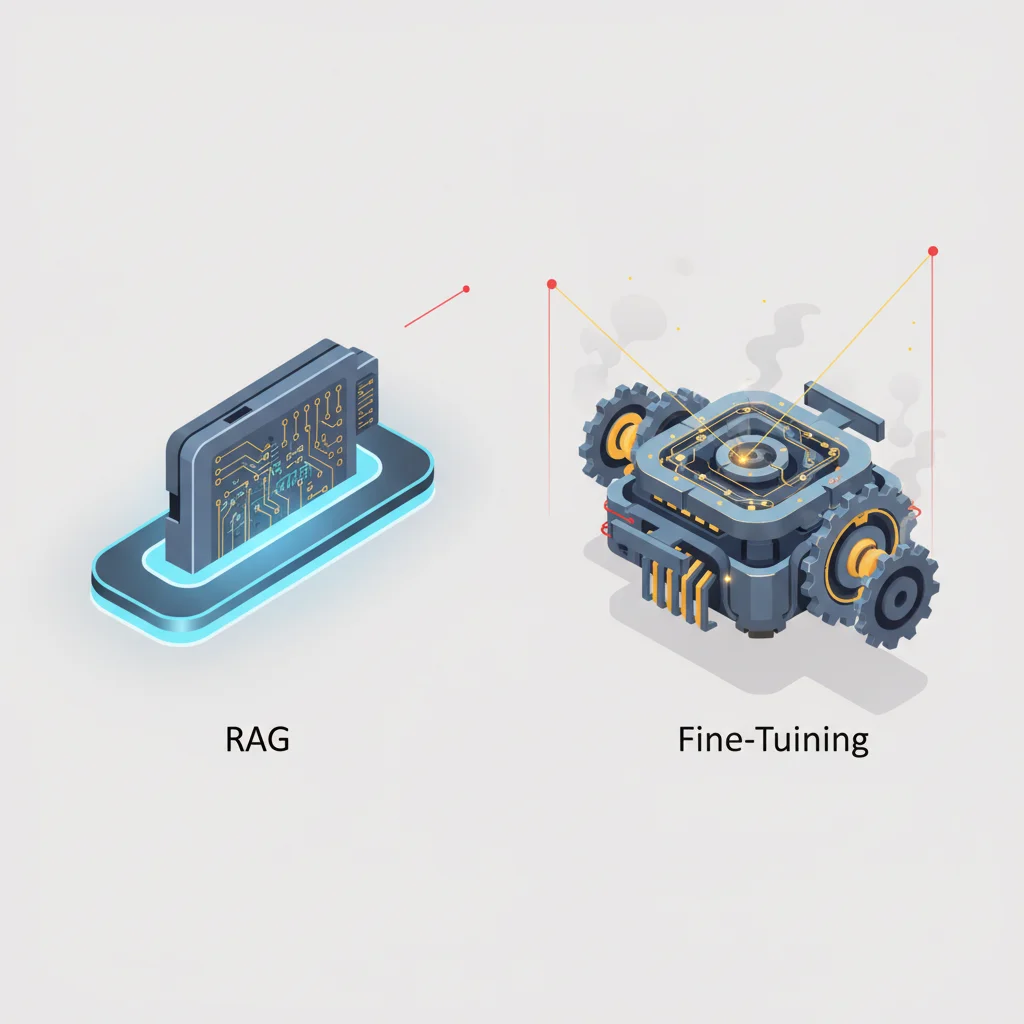
Comparing Methodologies: RAG's Flexibility vs. Fine-Tuning's Specialization
When attempting to adapt a Large Language Model to specialized corporate data, technology leaders are generally faced with two primary methodologies: Retrieval-Augmented Generation (RAG) and Fine-Tuning. Understanding the fundamental structural and behavioral differences between these two methodologies is essential for designing a successful corporate AI strategy.
Fine-Tuning is the process of taking an existing, pre-trained base model and performing additional training on a smaller, highly specialized dataset. This process actually alters the internal weights of the neural network. Fine-tuning does not teach the model new facts efficiently; rather, it is highly effective at teaching the model a specific style, tone, structured output format (such as forcing JSON output), or highly specialized domain vocabulary (such as medical terminology or legal jargon). It reshapes how the model communicates and processes instructions.
RAG, as established, does not modify the model’s weights. Instead, it provides the model with temporary access to external facts during the prompt cycle. It is a data-routing mechanism. While a fine-tuned model must memorize its specialized data within its parameters, a RAG system accesses its data dynamically from an external index. The table below outlines the core practical differentiators between these two methodologies:
Decision Factors for Enterprise AI Strategy
Selecting the optimal methodology depends on several distinct operational factors. The first is the nature of the data itself. If the data is dynamic, subject to frequent updates, and requires strict access permissions, RAG is the structurally correct choice. For instance, an internal knowledge base containing weekly product inventory updates, policy changes, and customer support manuals cannot be managed via fine-tuning without creating an endless, costly cycle of daily model training.
The second decision factor is the required behavioral specialization. If a company needs a model to output highly formatted medical transcripts in a very specific XML structure, or needs a model to write code in a proprietary internal programming language, fine-tuning is highly effective. In these scenarios, the model must deeply integrate specialized syntax, behavioral rules, and formatting patterns into its fundamental reasoning loops, which is difficult to enforce purely through prompt engineering and retrieval contexts.
The third factor is budget and engineering maturity. Developing a fine-tuning pipeline requires clean, highly curated datasets, dedicated data science teams, and significant infrastructure overhead. RAG pipelines, conversely, can be deployed rapidly by standard software engineers using modern orchestration frameworks and managed vector database APIs, offering a lower initial barrier to entry and more predictable operational costs.
When to Choose RAG Over Fine-Tuning for Data Integration
For the vast majority of enterprise data integration projects, RAG should be the default starting position. The primary reason is data governance and security. In most corporations, not all employees are authorized to view every document. For example, a standard customer support agent should not have access to executive HR compensation files, even though both files are stored in the corporate document repository.
Because RAG retrieves documents at query time, it can leverage existing enterprise access control systems. The vector database can filter out search results that the querying user does not have explicit permission to view, ensuring that the model never receives unauthorized information in its prompt context. With a fine-tuned model, enforcing document-level security is functionally impossible; once a piece of sensitive data is compiled into the model's weights during training, any user with access to the model can theoretically extract that information through clever prompting.
Additionally, RAG offers immediate auditability. When a generative system outputs a factual claim that seems questionable, developers must be able to trace exactly why the system generated that output. In a RAG pipeline, developers can review the exact chunks returned by the vector database, verify their validity, and correct any errors in the source documents. In a fine-tuned model, identifying the source of a specific hallucination requires complex, speculative model interpretability work, making quality control a difficult challenge.
A balanced evaluation of adopting a Retrieval-Augmented Generation framework for business operations. Pros 2 advantages Dynamic Factual Updates Instantly integrates new documents without model retraining or weight updates. Auditable Citations Traces generated answers back to source paragraphs for easy verification. Cons 2 concerns Retrieval Latency Introduces extra network hops and search time before generation begins. Vector Complexity Requires ongoing maintenance of vector databases, embeddings, and data pipelines.RAG Advantages and Constraints
Corporate Use Cases for Retrieval-Augmented Generation
Internal Knowledge Base Assistants and HR Chatbots
One of the most widespread deployments of RAG is the modernization of internal knowledge management. Large organizations possess vast repositories of information scattered across diverse platforms: share drives, Slack history, Notion workspaces, and Confluence wikis. Finding a specific company policy, benefit detail, or technical guideline inside this unorganized maze of documentation consumes significant employee hours.
By routing these disparate data sources into a centralized vector database, organizations can deploy an intelligent internal assistant. An employee can ask, "What is our parental leave policy for employees based in our London office, and how do I submit my request?" The retrieval engine searches the HR documents, pulls the specific clauses matching the UK region, and presents a clear, synthesized summary alongside links to the original policy PDF and the direct internal submission forms.
This transformation of static wikis into interactive, natural-language conversational assistants dramatically reduces the volume of repetitive inquiries routed to internal IT and HR support desks. Employees get immediate, accurate answers to their administrative questions, while HR professionals can focus on complex, high-touch employee relations issues.
Customer Support and Automated Ticketing Systems
In customer service operations, speed and precision are critical. Customers demand immediate answers to product questions, troubleshooting steps, and policy terms. Traditional automated chatbots rely on rigid decision trees that fail when a user deviates from a pre-determined script, leading to frustrated customers and high escalation rates to human support agents.
Integrating a RAG system into the customer support pipeline allows for the creation of responsive, context-aware digital assistants. The system can digest product manuals, warranty documents, and previous help-desk resolution logs. When a customer submits a complex query, the assistant retrieves the exact troubleshooting steps matching the specific product model and walks the customer through the solution in a helpful, conversational tone.
[Customer Query: "Model X blinking red"]
               │
               ▼
   [RAG System Retrieves Model X Manual - Section 4]
               │
               ▼
   [Generated Output: "Blinking red indicates a battery error. Please..."]
Because the assistant is grounded in the official product documentation, it will not speculate on product features, warranty terms, or pricing plans. This reliable factual boundary allows companies to safely deploy these conversational agents on public-facing channels, leading to a significant reduction in ticket volume, faster resolution times, and improved customer satisfaction scores.
Legal and Financial Document Analysis and Compliance
Legal and financial departments process vast quantities of highly dense, complex documentation daily. From reviewing multi-page vendor contracts and searching for liability terms, to auditing financial reports and ensuring compliance with evolving taxation codes, professionals spend significant time on manual document review.
RAG-powered tools act as highly efficient analytical partners for these specialized departments. When analyzing a new vendor agreement, a legal counsel can prompt the system: "Identify any clauses in this agreement that deviate from our standard indemnification requirements." The system retrieves the standard corporate compliance templates from the vector store, compares them section-by-section with the newly uploaded contract, and flags any discrepancies for manual review.
In the financial sector, RAG systems can index thousands of pages of SEC filings, market reports, and internal audit histories. Analysts can query the system to synthesize complex historical data, verify compliance with local banking regulations, and draft draft reports with precise page citations. This capability accelerates the research phase, letting analysts spend more time on strategic decision-making and risk mitigation.
Challenges and Cautions When Implementing RAG
Navigating Data Privacy and Security Protocols
While RAG provides a highly secure alternative to model retraining, it introduces its own set of technical security concerns. The most pressing is the issue of data transit. When utilizing proprietary or highly sensitive enterprise data, sending raw text chunks to external, public LLM APIs (such as the standard public endpoints of OpenAI or Anthropic) can violate regional data residency regulations or internal security policies.
To mitigate this risk, enterprise architects must establish robust security protocols. This includes utilizing enterprise-grade API agreements that explicitly guarantee zero data retention (ZDR)—meaning the LLM provider will not log, store, or use the incoming prompts to train their models. Alternatively, organizations can host open-weight frontier models (such as Llama 3 or Mistral) on private Virtual Private Clouds (VPC) or local corporate hardware. This ensures that the entire RAG pipeline—from document ingestion to response generation—remains entirely within the company’s secure network boundaries.
                                  [DATA PRIVACY BOUNDARY]
                                ┌─────────────────────────┐
[Internal Vector DB] ──[Secure]─► [Private Cloud LLM]      │
                                │ (E.g., Hosted in VPC)   │
                                └─────────────────────────┘
Furthermore, system designers must prevent prompt injection attacks. If an external user can manipulate the input prompt to bypass system instructions, they might trick the model into retrieving and displaying sensitive files from the underlying vector database. Implementing input sanitization layers and strict system instruction boundaries is critical to maintaining a secure corporate deployment.
Managing Vector Database Complexities and Scalability
Setting up a basic, local RAG prototype is relatively straightforward. However, scaling that prototype to support millions of documents and thousands of concurrent enterprise users introduces significant engineering challenges. As the volume of vectorized data grows, vector databases can experience latency degradation and increased operational costs.
One major challenge is the phenomenon of vector drift and search degradation. As new documents are continuously added to the index, the spatial distribution of the vectors can change, leading to less accurate similarity search results over time. Maintaining search quality requires constant monitoring, indexing adjustments, and occasional complete rebuilds of the vector database index using updated embedding models.
[Vector Database Growth] ──► [Index Fragmentation] ──► [Search Degradation]
                                                               │
                                                       [Requires Re-indexing]
Additionally, handling metadata filtering at scale requires highly optimized database configurations. If a user queries the system and restricts the search to "documents created only in Q3 of 2025 by the APAC marketing team," the database must perform a combined relational and vector search. Efficiently executing these hybrid queries without introducing severe latency requires careful design of database indexes, metadata structures, and hardware resource allocations.
The Risk of Flawed or Biased Source Data
A RAG pipeline is fundamentally bound by the quality of the information it retrieves—a classic manifestation of the computer science axiom: "garbage in, garbage out." If the underlying corporate knowledge base contains outdated PDFs, contradictory policy manuals, or poorly written documentation, the retrieval engine will faithfully feed this flawed context directly to the LLM.
The language model, despite its sophisticated reasoning capabilities, has no native ability to determine if a retrieved document contains a factual error or an outdated policy. It will synthesize the provided text and present the incorrect information to the user with high conversational confidence. This can lead to situations where different corporate divisions receive conflicting guidance because the vector database retrieved older, un-archived versions of policy documents.
To prevent this, organizations must establish rigorous data-cleaning pipelines. Prior to vectorization, all corporate documentation must be audited, organized, and deduplicated. Outdated files must be systematically archived or deleted from the active ingestion pipelines. Without a continuous, disciplined data hygiene protocol, a RAG system will rapidly propagate internal misinformation and erode employee trust in the technology.
Best Practices for a Secure RAG Integration

Establishing Robust Data Governance and Access Controls
To safely deploy a RAG system within an enterprise, integrating Document-Level Security (DLS) is a critical requirement. This ensures that the retrieval mechanism respects existing corporate hierarchy and access rights. When a user submits a query, the system must append the user's security credentials and group memberships to the retrieval query. The vector database then filters the search results, ensuring that only document chunks the user is explicitly authorized to access are retrieved and sent to the LLM.
[User Query + Security Token]
              │
              ▼
   [Vector DB Filters Index] (Reads only permitted collections)
              │
              ▼
   [Only Authorized Chunks Sent to LLM Context Window]
In addition to DLS, organizations must establish clear data retention and classification policies. Sensitive data (such as personally identifiable information, financial ledgers, or customer health records) should either be excluded from the RAG pipeline entirely or run through a real-time data-loss prevention (DLP) tool. These tools automatically redact sensitive tokens, social security numbers, or credit card details before the text chunks are converted into vectors or sent to external model APIs.
Finally, regular security audits and logging are essential. Every step of the RAG pipeline—including user queries, retrieved document IDs, generated prompts, and model responses—should be logged in a secure, tamper-proof audit trail. This allows security teams to monitor for unauthorized data access patterns, identify potential prompt-injection attempts, and verify ongoing compliance with data protection laws.
Optimizing Vector Store Management and Retrieval Strategies
Achieving high factual accuracy in a RAG system requires going beyond basic vector similarity searches. Standard semantic search can sometimes retrieve chunks that are conceptually related but lack the specific factual details required to answer the user's query. To resolve this, enterprise architects should implement a hybrid search strategy.
Hybrid search combines the strengths of dense vector search (which captures conceptual meaning and context) with sparse keyword search algorithms like BM25 (which excels at matching precise product codes, serial numbers, names, and technical terms). By combining both retrieval techniques and normalizing their scores using algorithms like Reciprocal Rank Fusion (RRF), the retrieval engine consistently delivers a more balanced and highly relevant set of document chunks.
[User Query] ──┬──► [Dense Vector Search (Semantic Meaning)] ──┬──► [Rank Fusion (RRF)] ──► [Top Chunks]
               └──► [Sparse BM25 Search (Keyword Matching)]  ──┘
Furthermore, utilizing a secondary re-ranking model is highly recommended. The initial vector search is optimized for speed and retrieves a broad set of candidate documents (e.g., top 20 chunks). These candidates are then passed to a computationally intensive re-ranking model, which evaluates the exact semantic relationship between the query and each chunk, re-ordering them to ensure the top 3-5 most informative chunks are positioned at the very front of the final prompt payload.
Ensuring Data Quality and Relevance for Optimal Performance
Maintaining high performance over time requires a continuous focus on document hygiene and evaluation. Enterprises must view their vector databases not as static archives, but as dynamic, living libraries that require regular curation. This includes setting up automated pipelines that flag duplicate files, resolve contradictory statements across different document versions, and automatically archive outdated materials.
To measure the effectiveness of a RAG pipeline, teams should adopt quantitative evaluation frameworks such as Ragas or TruLens. These frameworks assess the performance of the system across several core dimensions:
Context Precision: Measures whether all retrieved chunks are highly relevant to the query, minimizing noise.
Context Recall: Evaluates whether the system retrieved all the necessary information required to formulate a complete answer.
Faithfulness: Verifies if the model’s generated response is grounded strictly in the retrieved context, identifying any subtle hallucinations.
Answer Relevance: Evaluates how directly the final generated response addresses the user’s original question.
By continuously tracking these metrics in staging and production environments, engineering teams can make data-driven adjustments to chunk sizes, overlap parameters, system instructions, and embedding models, ensuring the RAG platform remains highly reliable, accurate, and valuable to the organization.
Frequently Asked Questions
Why use RAG instead of fine-tuning?
RAG dynamically retrieves real-time, verified documents to ground generative responses without changing model weights, whereas fine-tuning alters model weights to adjust behavior and style but remains static and costly to update.
Does RAG completely prevent AI hallucinations?
While RAG significantly reduces hallucinations by constraining the generative model to a specific, verified set of source materials, it does not completely eliminate the risk if the source documents are inaccurate or if the model's system prompt instructions are poorly configured.
What infrastructure is required to support RAG?
A production-grade RAG pipeline requires a document ingestion system, an embedding model to convert text to mathematical vectors, a high-performance vector database to store and search those vectors, and an orchestration framework like LangChain or LlamaIndex to coordinate the pipeline.
How does RAG handle data security and document permissions?
RAG manages security by integrating with existing Role-Based Access Control systems, allowing the vector database to filter out search results that the querying user is not authorized to view, ensuring private data never enters the prompt context window.
Can RAG be deployed entirely on-premises?
Yes, organizations with strict compliance requirements can host open-weight models and vector databases inside their private clouds or physical on-premises servers, keeping all sensitive corporate data inside their internal networks.
What is chunking and why is it important in RAG?
Chunking is the process of breaking down large corporate documents into smaller, logically coherent text segments, which is necessary because generative models have strict limits on the number of tokens they can process in a single prompt window.
How long does it take to implement a basic RAG system?
A functional, basic RAG prototype can be developed within a few days using modern orchestration APIs and managed vector databases, while a production-ready, enterprise-scale system with secure access controls and data pipelines typically requires several weeks to implement.
What is hybrid search in a RAG framework?
Hybrid search is a retrieval technique that combines dense vector search, which understands semantic meaning, with traditional sparse keyword search to maximize retrieval accuracy and ensure exact matches for specific codes or terms.