
What Is TypeScript and How Is It Different from JavaScript?
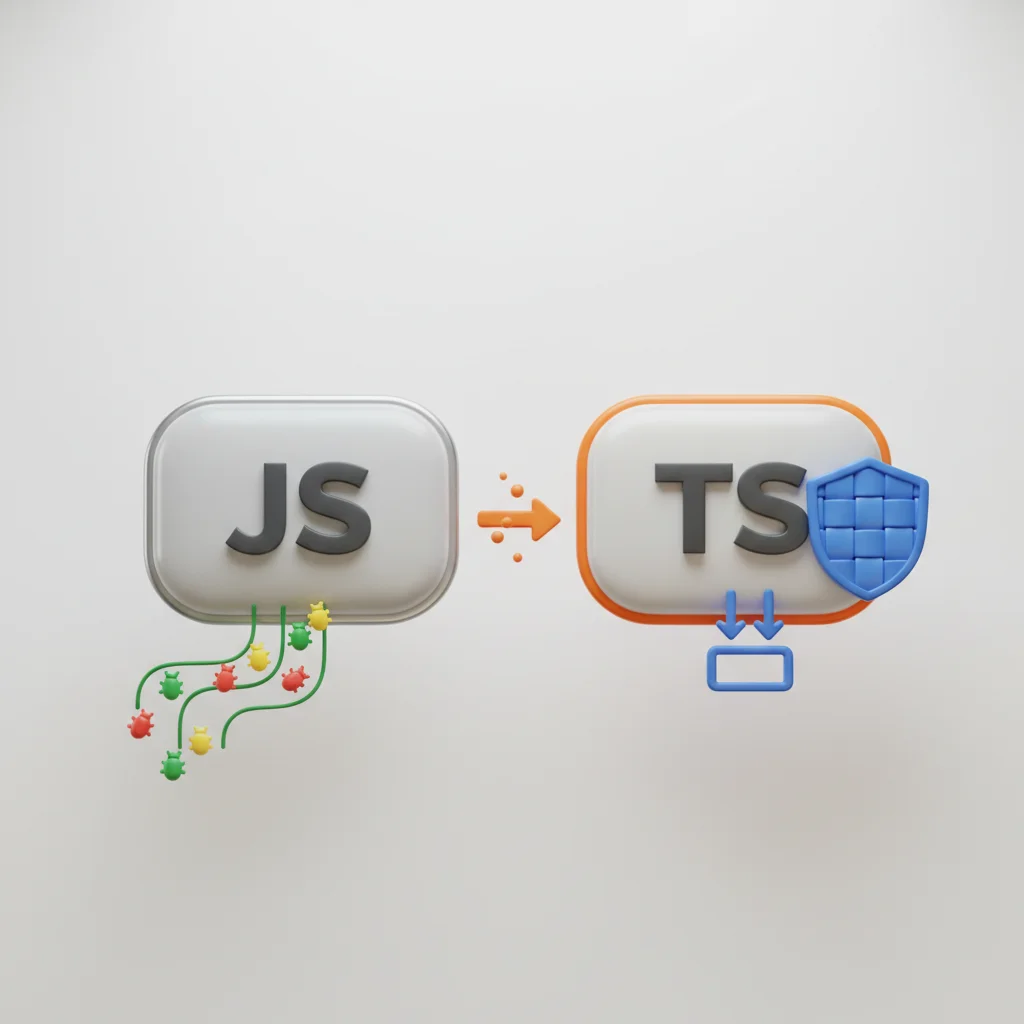
TypeScript is a strongly typed superset of JavaScript that enhances code quality and scalability by catching errors at compile time rather than runtime.
ON THIS PAGE
0% read
- The Strategic Shift in Web Development
- Defining the Baseline: What Is JavaScript?
- What Is TypeScript? A Strongly Typed Superset
- Core Structural Differences: TypeScript vs. JavaScript
- Why Enterprises Are Adopting TypeScript for Scalability
- Cautionary Considerations: The Drawbacks of TypeScript
- Strategic Decision Making: When to Choose Which
TypeScript is a strongly typed superset of JavaScript that enhances code quality and scalability by catching errors at compile time rather than runtime. For engineering leaders, technical founders, and enterprise architects evaluating modern stack decisions, understanding What Is TypeScript and How Is It Different from JavaScript? is critical to optimizing development velocity, reducing long-term technical debt, and establishing a resilient codebase architecture. This comprehensive guide examines the technical distinctions, operational trade-offs, and strategic decision frameworks required to determine when to leverage TypeScript over standard JavaScript in production environments.
The Strategic Shift in Web Development
The landscape of web software engineering has transformed from isolated script injections to mission-critical, enterprise-grade cloud applications. In the early eras of browser scripting, development teams managed small scripts intended primarily for user interface enhancements, basic DOM manipulation, and lightweight form validations. Today, single-page applications (SPAs), micro-frontends, and distributed server-side Node.js runtimes frequently govern mission-critical enterprise systems handling high-frequency transactions and regulatory compliance data.
As application complexity grew exponentially, the foundational architecture of dynamic web languages began displaying structural limitations when applied to large-scale development teams. When distributed engineering organizations collaborate across hundreds of thousands of lines of code, the absence of rigid contractual interfaces creates significant friction. Teams without automated architectural constraints spend disproportionate engineering hours tracing silent runtime failures and performing regression testing across integrated microservices.
Understanding the Need for Architectural Robustness
Architectural robustness in enterprise applications requires clear data contracts between client applications, backend services, and external APIs. In a rapidly evolving software development lifecycle (SDLC), engineering velocity is directly throttled by the fear of introducing breaking changes during major refactoring efforts. When interfaces and object models are loosely defined, minor modifications to shared utility libraries can ripple across an entire system without immediate detection.
To maintain engineering velocity and code maintainability, organizations demand systems that enforce deterministic type structures and rigorous contract guarantees. Moving validation from manual review cycles into automated static analysis pipelines reduces operational friction, speeds up CI/CD pipeline integration, and ensures that cross-functional engineering teams can refactor core business logic with predictable outcomes.
Defining the Baseline: What Is JavaScript?
JavaScript is an interpreted, high-level, dynamically typed programming language standardized under the ECMAScript specifications (ECMA-262). Created initially by Brendan Eich in 1995 to add interactivity to Netscape Navigator, JavaScript has evolved into the most universally supported programming language in the global technology ecosystem. Modern JavaScript engines, such as Google's V8 (used in Chrome and Node.js) and Apple's JavaScriptCore (Safari), utilize sophisticated Just-In-Time (JIT) compilation to transform human-readable script into high-performance machine code during execution.
Because JavaScript natively powers the client-side execution layer of every modern web browser, it remains an indispensable technology for web development. Its event-driven, non-blocking I/O model allows developers to construct responsive user interfaces and scalable network servers with minimal runtime configuration overhead.
JavaScript's Dynamic Nature and Its Strengths
The primary strength of JavaScript lies in its dynamic typing and rapid prototyping capabilities. In JavaScript, variables are not bound to specific data types; instead, types are associated with the runtime values themselves. This flexibility permits developers to rapidly construct features, alter data payloads dynamically, and pass polymorphic data structures through functional pipelines without writing verbose structural boilerplate.
// Dynamic typing in JavaScript: variables can hold any data type at runtime
let transactionPayload = { id: "tx_101", amount: 250.00 };
transactionPayload = "Transaction Cancelled"; // Valid JavaScript, but prone to runtime logic errors
This flexibility drastically shortens initial prototyping cycles. Small development teams, early-stage startups, and solo engineers can ship functional minimum viable products (MVPs) without building complex abstract hierarchies or pre-defining rigorous domain interfaces. Furthermore, because JavaScript requires no compilation step, engineers benefit from instant feedback loops during local development.
Challenges of JavaScript in Large Codebases
While dynamic typing accelerates early prototyping, it poses severe maintainability risks in enterprise systems containing hundreds of modules. Because type checking is deferred until runtime, subtle bugs—such as referencing properties on undefined objects or passing mismatched parameter structures to functions—frequently bypass staging environments and trigger production incidents.
// Common JavaScript runtime issue: implicit type coercion and undefined access
function calculateDiscount(user, discountRate) {
  return user.profile.tier === "enterprise" ? user.balance * discountRate : 0;
}

// Runtime Exception: Cannot read properties of undefined (reading 'tier')
calculateDiscount({}, 0.15);
As engineering teams scale, the cognitive load required to understand undocumented function signatures increases exponentially. Developers must continuously inspect function implementations to deduce parameter requirements, leading to slower onboarding, higher rates of defect introduction, and escalating technical debt across long-term product lifecycles.
What Is TypeScript? A Strongly Typed Superset
TypeScript is an open-source, strongly typed programming language developed and maintained by Microsoft. Architecturally, TypeScript is defined as a syntactic superset of JavaScript. This means that every valid JavaScript program is syntactically valid TypeScript code. TypeScript extends the base JavaScript language by introducing an explicit type system, compile-time static type checking, type annotations, and advanced object-oriented constructs such as interfaces, generics, and algebraic data types.
The core premise of TypeScript is that developers should receive immediate structural feedback while authoring code, long before that code executes in an end-user's browser or a production server environment. The language was created by Anders Hejlsberg (lead architect of C# and Turbo Pascal) and officially released in October 2012 to address the challenges of building large-scale JavaScript applications.
The Core Definition: TypeScript as a Superset
Because TypeScript is a strict superset, it does not invent an alternative execution engine. Web browsers, Node.js runtimes, and mobile web views cannot execute @@CODE0@@ files directly. Instead, TypeScript relies on a compiler—the TypeScript Compiler (@@CODE1@@) or modern transpilation engines such as Babel, SWC, or esbuild—to perform type stripping and transpile TypeScript source code into standard ECMAScript-compliant JavaScript (.js).
[ TypeScript Source (.ts) ]
         │
         ▼  (Static Type Checking & Type Stripping via 'tsc' / SWC)
[ Standard JavaScript (.js) ]
         │
         ▼  (Executed by V8, Node.js, Bun, or Browser Engines)
[ Runtime Output ]
This superset architecture guarantees that adopting TypeScript does not break existing dependencies. Engineering teams can seamlessly integrate existing JavaScript libraries, utility packages, and legacy modules while gradually introducing static type safety to critical business domains.
Compile-Time Error Detection for Enhanced Quality
The most significant operational advantage of TypeScript is compile-time error detection. In standard JavaScript, a typo in an object key or a mismatch in API response parsing results in a runtime exception (TypeError: obj is undefined) during user execution. TypeScript identifies these discrepancies immediately inside the integrated development environment (IDE) and during the CI compilation step.
// Strict interface definition in TypeScript
interface UserProfile {
  tier: "standard" | "enterprise";
}

interface User {
  id: string;
  balance: number;
  profile: UserProfile;
}

function calculateDiscount(user: User, discountRate: number): number {
  return user.profile.tier === "enterprise" ? user.balance * discountRate : 0;
}

// Compile Error: Property 'profile' is missing in type '{}' but required in type 'User'.
calculateDiscount({}, 0.15);
By shifting error detection from runtime to compile time, TypeScript acts as a continuous, automated static testing layer. Empirical industry studies indicate that static type systems can prevent between 15% and 38% of common public software defects from ever reaching production environments.
Compatibility with Existing JavaScript Code
TypeScript achieves zero-friction backwards compatibility through its flexible configuration system managed via tsconfig.json. Organizations are not forced to perform a total rewrite of their existing codebases. Instead, they can configure the TypeScript compiler to operate under varying degrees of strictness:
@@CODE0@@: Permits the coexistence of @@CODE1@@ and
.tsfiles within the same project directory.checkJs: true: Instructs the compiler to provide static type checking on vanilla JavaScript files using JSDoc annotations.strict: true: Enables the full suite of static analysis protections, including strict null checks and explicit parameter typing.
This compatibility enables a phased migration model where high-risk payment modules or core data models can be migrated to TypeScript first, while peripheral UI components remain in vanilla JavaScript until engineering capacity permits refactoring.
Core Structural Differences: TypeScript vs. JavaScript
Understanding the divergence between TypeScript and JavaScript requires analyzing how both languages handle type assignment, compilation, abstraction, and memory safety. While both ultimately resolve to JavaScript bytecode inside the host runtime, their development-time semantics differ fundamentally.
Static Typing vs. Dynamic Typing
The fundamental distinction lies in typing mechanics. JavaScript uses dynamic typing, where variable types are resolved and coerced dynamically at runtime. A variable initialized with a numeric value can be reassigned to an array, an object, or a function without raising syntax errors.
TypeScript implements static typing using a structural type system (often described as static duck typing). In TypeScript, variable types are either explicitly declared via type annotations or automatically deduced through sophisticated type inference. Once inferred or declared, the compiler prohibits type-violating assignments across all execution paths.
// Type Inference and Strict Assignment
let systemVersion = 4.2; // TypeScript automatically infers the type 'number'
systemVersion = "v4.2.1"; // Compile Error: Type 'string' is not assignable to type 'number'.
Furthermore, TypeScript supports union types, intersection types, and template literal types, enabling developers to express complex domain states directly in the type system without writing manual runtime validation assertions.
type DeploymentEnvironment = "development" | "staging" | "production";
type AccessRole = "read" | "write" | "admin";

interface UserCredential {
  userId: string;
  roles: AccessRole[];
  allowedEnvironments: DeploymentEnvironment[];
}
Compile-Time Verification vs. Runtime Failures
In a vanilla JavaScript application, syntax validation occurs when the engine parses the script immediately before execution. If a runtime path contains a non-existent method call, that defect remains dormant until a user action executes that specific code branch.
TypeScript introduces a mandatory compilation phase. During this step, the TypeScript compiler checks the abstract syntax tree (AST) against the declared type constraints. If any variable fails type consistency checks, compilation fails, halting the deployment pipeline before defective artifacts reach production servers.
interface PaymentGateway {
  charge(amount: number, currency: "USD" | "EUR"): Promise<boolean>;
}

class StripeService implements PaymentGateway {
  // Compile Error if signature deviates from the PaymentGateway interface
  async charge(amount: number, currency: "USD" | "EUR"): Promise<boolean> {
    // Implementation logic
    return true;
  }
}
Object-Oriented Programming (OOP) Capabilities
While modern JavaScript (ES6+) introduced class syntax, inheritance, and basic private fields (via the # prefix), TypeScript provides an enterprise-grade object-oriented programming toolset comparable to languages such as Java or C#.
TypeScript offers:
Interfaces: Pure contractual abstractions that describe the shape of objects without generating runtime overhead.
Generics: Parameterized types that enable the creation of reusable, type-safe data structures and utility functions.
Access Modifiers: @@CODE0@@, @@CODE1@@, @@CODE2@@, and @@CODE3@@ modifiers that enforce encapsulation boundaries at compile time.
Abstract Classes: Base classes that cannot be instantiated directly and require concrete subclass implementations.
// Generic Repository Pattern in TypeScript
interface Entity {
  id: string;
}

abstract class BaseRepository<T extends Entity> {
  protected abstract databaseTable: string;

  public async getById(id: string): Promise<T | null> {
    // Shared database lookup logic
    return null;
  }

  public abstract validate(item: T): boolean;
}Comparative assessment of JavaScript versus TypeScript across core enterprise development dimensions. Avantaj TypeScript: Enforces strict data contracts across distributed teams and micro-frontends. Dezavantaj JavaScript: Increases risk of breaking changes as codebase surpasses 50,000 lines. Avantaj JavaScript: Immediate execution with zero compilation, transpilers, or tooling configuration. Dezavantaj TypeScript: Requires setup of tsconfig, build scripts, and type definitions for external modules. Avantaj TypeScript: IDE-driven global refactoring automatically updates all dependent modules. Dezavantaj JavaScript: Refactoring requires extensive manual search-and-replace and high unit test coverage.Decision Matrix: Language Selection by Project Criteria
Codebase Scale & Team Distribution
Development Setup Speed & Prototyping
Long-Term Refactoring Safety
Why Enterprises Are Adopting TypeScript for Scalability
For corporate technology leaders and enterprise engineering organizations, adopting TypeScript is rarely an aesthetic choice; it is a risk mitigation strategy. As software architectures transition to large distributed codebases, the operational costs of defect remediation, code refactoring, and developer onboarding escalate dramatically.
Major enterprise platforms—including Microsoft, Slack, Airbnb, Uber, and Bloomberg—have systematically migrated their core web codebases to TypeScript. Their engineering post-mortems consistently cite enhanced developer productivity, predictable code maintenance, and automated self-documenting codebases as the core drivers behind migration investments.
Proactive Risk Mitigation and Reduced Technical Debt
In large-scale web applications, technical debt accumulates when code becomes too opaque or brittle to modify safely. In JavaScript, modifying a widely used data model requires engineers to manually trace every downstream consumer across multiple repositories. A single unhandled edge case—such as receiving a null value where a string was expected—can bring down key user workflows.
TypeScript mitigates this risk by enforcing strict null safety (strictNullChecks: true). The compiler actively forces developers to account for missing, null, or undefined data states before writing business logic:
interface CustomerAccount {
  name: string;
  email?: string; // Optional property
}

function sendNotification(customer: CustomerAccount): void {
  // Compile Error: Object is possibly 'undefined'.
  // customer.email.toLowerCase();

  // Correct pattern enforced by compiler:
  if (customer.email) {
    console.log(`Dispatching to ${customer.email.toLowerCase()}`);
  }
}
By converting runtime fragility into explicit, type-checked control flow guards, enterprise systems experience substantially lower post-deployment failure rates.
Enhanced IDE Support and Code Refactoring
Developer productivity in modern enterprise environments is heavily reliant on the capabilities of the integrated development environment (IDE), such as Visual Studio Code, WebStorm, or Neovim. TypeScript's static type graph powers rich language server features that are impossible to achieve reliably in dynamic JavaScript:
Intelligent Autocompletion (IntelliSense): Developers receive instant property suggestions, method signatures, and documentation tooltips directly as they type.
Deterministic Code Refactoring: Renaming a method, updating an interface property, or reordering parameters automatically updates all call sites across an enterprise monorepo with 100% precision.
Self-Documenting Code: Type definitions serve as executable, compile-checked documentation that never goes out of date. New engineers can understand external API interfaces without reading external documentation wikis.
// Self-documenting API contract with Generics and JSDoc
interface PaginatedResponse<TData> {
  data: TData[];
  totalRecords: number;
  currentPage: number;
  hasNextPage: boolean;
}

interface OrderRecord {
  orderId: string;
  amountCents: number;
  settledAt: string;
}

// Function signature immediately conveys input parameters and return guarantees
async function fetchOrders(page: number): Promise<PaginatedResponse<OrderRecord>> {
  const response = await fetch(`/api/v1/orders?page=${page}`);
  return response.json();
}
Cautionary Considerations: The Drawbacks of TypeScript
Despite its technical advantages, TypeScript is not an architectural panacea. Implementing TypeScript introduces concrete operational overhead, tooling complexity, and organizational friction that decision-makers must evaluate prior to enterprise-wide standardization.
A pragmatic technical evaluation requires understanding where TypeScript can slow down development velocity or introduce unnecessary engineering friction.
The Overhead of Compilation and Tooling
Unlike JavaScript, which can be executed directly in modern runtimes, TypeScript requires a dedicated transpilation step. In massive monorepos containing millions of lines of code, full type checking passes via tsc can introduce latency into CI/CD deployment pipelines.
While modern tooling such as Vite, esbuild, and SWC has drastically reduced local hot-reloading times by stripping types without full type verification, the complete static type checking pipeline still must run during continuous integration. If misconfigured, build times can increase, slowing down deployment frequency.
Additionally, development teams must manage type definition packages (@@CODE0@@ via DefinitelyTyped) for third-party JavaScript libraries. When external open-source packages maintain outdated or inaccurate type definitions, developers are forced to write custom ambient declaration files (@@CODE1@@), introducing maintenance overhead.
Steep Learning Curve and Onboarding Friction
JavaScript developers transitioning to TypeScript face a significant conceptual learning curve. Mastering basic type annotations is straightforward, but enterprise TypeScript architectures frequently demand proficiency in advanced type system features:
Conditional Types (
T extends U ? X : Y)Mapped Types (
{ [K in keyof T]: T[K] })Template Literal Types
Discriminated Unions and Type Predicates (
value is CustomType)Complex Generics with recursive constraints
Junior engineers or developers coming exclusively from dynamically typed scripting backgrounds can struggle with compiler errors, resulting in slower initial development velocity during the first several months of adoption.
The Risk of Over-Engineering
A frequent antipattern in TypeScript projects is over-engineering type signatures. When developers prioritize achieving 100% abstract type safety over shipping working business logic, they can create overly complex, unreadable generic structures that obfuscate code intent.
// Antipattern: Over-engineered type abstraction that hinders readability
type DeepNestedValueExtractor<T, K extends keyof T> = T[K] extends Record<string, any>
  ? { [P in keyof T[K]]: T[K][P] extends (...args: any[]) => infer R ? R : T[K][P] }
  : T[K];
Furthermore, frustrated developers encountering difficult compiler errors may resort to using the @@CODE0@@ escape hatch (@@CODE1@@). Overusing any completely disables type checking for that variable and propagates untyped dynamic behavior across the codebase, negating the architectural benefits of TypeScript while retaining all the build-time overhead.
Operational benefits versus structural trade-offs for development organizations. Pros 3 advantages Superior Refactoring Safety Enables safe, confident cross-codebase refactoring with zero manual regressions. Self-Documenting Architecture Eliminates out-of-date API wikis by treating interfaces as living code contracts. Production Runtime Defect Reduction Eliminates common undefined property errors and type mismatches before deployment. Cons 3 concerns Mandatory Compilation Pipeline Requires build tooling (esbuild, SWC, tsc) and increases CI/CD pipeline duration. Upfront Developer Learning Curve Demands intermediate-to-advanced mastery of static type theory and generics. External Type Definition Lag Relies on third-party DefinitelyTyped packages that may fall out of sync with libraries.Balanced Evaluation: Enterprise TypeScript Adoption
Strategic Decision Making: When to Choose Which
The decision to standardize on TypeScript or remain with native JavaScript must be aligned with organizational scale, product lifecycle stages, team competencies, and long-term maintenance horizons. Technology leaders should avoid dogmatic mandates and evaluate specific project requirements against clear criteria.
                    [ Project Scope & Team Evaluation ]
                                    │
       ┌────────────────────────────┴────────────────────────────┐
       ▼                                                         ▼
[ Enterprise / Long-Term ]                               [ MVP / Rapid Prototype ]
 • Team Size: > 3 Engineers                               • Team Size: 1-2 Engineers
 • Codebase: > 10,000 Lines                               • Codebase: Throwaway / Short Lifecycle
 • Microservices / Shared Models                          • High Domain Uncertainty
       │                                                         │
       ▼                                                         ▼
[ Recommend: TypeScript ]                                [ Recommend: Modern JavaScript ]
Scenarios Where JavaScript Remains Sufficient
JavaScript is often the optimal, high-velocity choice under specific organizational and technical conditions:
Early-Stage MVPs and Throwaway Prototypes: When a startup or innovation team is validating market-fit and the core data models change daily, the overhead of maintaining strict type interfaces can impede rapid feature iteration.
Small Teams and Short-Lived Projects: For marketing landing pages, simple automation scripts, micro-utilities, or single-developer applications with an expected lifecycle of under 12 months, vanilla JavaScript requires zero build configuration.
Performance-Critical JIT Optimization Hooks: In specialized, low-level numerical computing or graphic engine scripting where exact object memory layout shapes must be manually manipulated for V8 hidden class optimization, raw JavaScript can provide more direct control without compiler interference.
Scenarios Demanding TypeScript Implementation
TypeScript is the clear strategic standard for the following architectural environments:
Enterprise Applications with Multi-Team Contributions: When more than 3-5 engineers commit code to a shared repository, TypeScript's explicit contracts eliminate cross-team miscommunication regarding data structures.
Complex SaaS Products and FinTech Platforms: Applications managing financial transactions, complex permissions, sensitive healthcare data, or multi-tenant database operations require strict compile-time verification to prevent catastrophic runtime exceptions.
Open-Source Libraries and Shared Internal SDKs: Building reusable libraries, component design systems, or internal API clients in TypeScript provides consuming developers with instant autocomplete, type checking, and integrated documentation.
Long-Term Legacy Systems: When a codebase is expected to be maintained, upgraded, and refactored over a multi-year horizon by successive generations of developers, TypeScript significantly reduces long-term maintenance costs.
Frequently Asked Questions
Can TypeScript run natively inside a web browser?
No, modern web browsers cannot execute TypeScript code directly. TypeScript files (.ts) must be compiled or transpiled into standard ECMAScript-compliant JavaScript (.js) using compilers like tsc, Babel, or SWC before execution.
Is TypeScript ultimately replacing JavaScript?
No, TypeScript is not replacing JavaScript. TypeScript is designed as a superset that compiles down to JavaScript, meaning its continued relevance and execution model depend entirely on the underlying JavaScript ecosystem and ECMAScript standards.
How difficult is the migration from JavaScript to TypeScript for an existing codebase?
Migration can be performed incrementally without full rewrites. By enabling allowJs in tsconfig.json, teams can introduce TypeScript file by file, starting with core business models and utility functions while leaving legacy JavaScript files intact.
Does using TypeScript slow down application runtime performance?
No, TypeScript has zero direct impact on runtime performance. All type annotations and interfaces are completely stripped away during compilation, producing standard JavaScript that executes at identical speeds.
What is the primary difference between an interface and a type alias in TypeScript?
Interfaces are primarily used to define the shape of objects and can be merged via declaration merging. Type aliases are more versatile and can represent unions, primitives, tuples, and complex mapped types.
Can I use existing npm JavaScript libraries in a TypeScript project?
Yes, TypeScript seamlessly interacts with regular JavaScript packages. If a package lacks built-in types, you can install community-maintained type definitions from the DefinitelyTyped repository via the @types namespace.
What does the strict mode flag do in the TypeScript compiler?
The strict flag enables a broad suite of rigorous type-checking behaviors, including strictNullChecks, noImplicitAny, strictFunctionTypes, and strictBindCallApply, ensuring maximum compile-time safety across the codebase.
Why do some development teams choose vanilla JavaScript over TypeScript?
Teams often choose JavaScript to avoid build-step overhead, eliminate tooling configuration, and maximize development speed during early-stage prototyping where data structures evolve too rapidly to justify maintaining strict interfaces.